

Share | |
Mr. Nysse

Architecture & Design

Assessing Feasibility: Rules of Thumb and Factors That Influence Them

By Douglas Nysse, Principal, Kahler Slater

Our passion for hospitality has allowed us to partner with visionary clients throughout the United States and internationally. We are fortunate to have been involved in many successful hotel and resort projects. As a result, we are often asked to provide our opinion regarding the feasibility of hotel projects - whether they are new construction, adaptive reuse, or remodelings. For new construction and adaptive reuse projects, we are asked to provide a “gut check” to see if it is even worth the developer’s effort to engage in a market study. There are a few rules of thumb that we use to quickly evaluate feasibility. While these don’t provide the depth of research that market studies provide regarding historical demand, rate, occupancy, supply, and competitive risks, they have been helpful to our clients in making early decisions that allow them to spend their money and our time more wisely.

There are three primary factors we evaluate initially in the development deal – hotel segmentation, development cost, and average daily rate (ADR).

Hotel segmentation will affect the gross area of a hotel and level of finish for the building. Obviously, an economy hotel will have a different level of finish than an upper-upscale hotel. And a rooms-only select service hotel will have smaller rooms and less public space than a luxury full-service hotel with its restaurants, ballrooms, spa, retail and so on. Therefore, the luxury hotel will have a much higher gross area per key.

Development cost comprises not only construction cost but also includes furniture, fixtures and equipment (FF&E), operating supplies and equipment (OS&E), design and engineering fees, legal expenses, development fees, land acquisition, financing costs and other components that together generally total 35% to 50% of construction cost. The total development cost is driven by the total gross area multiplied by the construction cost with the other soft costs added, less credits, subsidies and other financial assistance.

ADR is the average daily rate after a stabilization period and an assumption of achieving at least fair market occupancy penetration. ADR and occupancy are used to calculate revenue per available room (RevPAR).

There are rules of thumb for each for each of these factors and methods to positively influence each of them. One method of evaluation is the ADR rule of thumb. When applied to new hotels, the rule of thumb says that for every $1 dollar in projected ADR, you can spend $1,000 in development costs. That is a 1:1,000 ratio. Or the other way around - for every $1,000 of development cost, a hotel projects $1 in ADR. We apply the rule exclusive of land cost. So if a 200-key upper-upscale hotel costs $45,000,000, that equates to $225,000 per key. Apply the ADR rule of thumb and the projected stabilized ADR should be around $225. We understand that every market is different and that other factors such as owner’s return requirements, labor costs and hotel segmentation also affect the ratio. However, research over the last ten years has found the rule to be very consistent. We have found that this rule provides a great “gut check” for capital investments.

When applied to remodelings of operating hotels, the ADR rule of thumb ratio changes and generally allows obtaining an incremental increase of $1 in ADR for less than $1,000. This is because many fixed and variable costs such as land acquisition and staff salaries are already in place. We use different ratios depending on many factors, including maintaining existing hotel segmentation within the competitive set or repositioning up to a higher hotel segment. For this example, let’s assume a ratio of 1:750. That is, for every $1 dollar in projected ADR increase, you can invest $750 in development costs. Or vice versa, for every $750 invested, you should expect to increase the ADR by $1. A simple example is the 200-key hotel. A $1,500,000 reinvestment equates to $7,500 per key. That investment should expect to drive a $10 ADR increase.

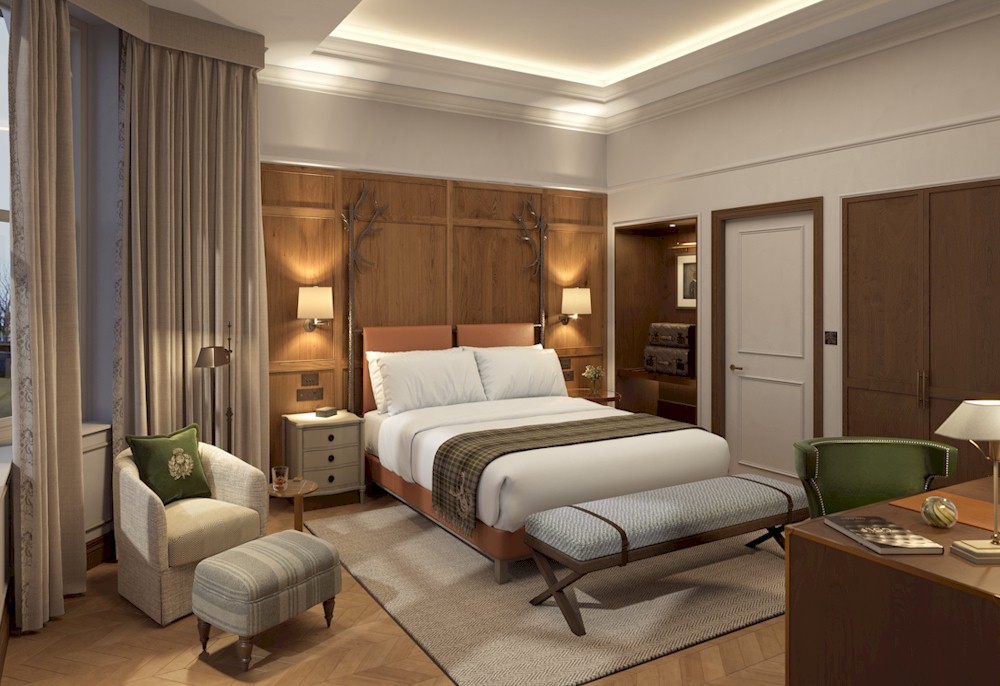
In most hotels and resorts, not all guestrooms are created equal and that’s okay. Without a doubt, the guest experience must be terrific in any guestroom. We look for ways to create rate segmentation through guestroom differentiation. Examples of differentiation include view, size, height, and amenities. Let’s expand on view as one example. The view premium affects how we lay out new-build properties and how we prioritize remodeling decisions. We’ve been studying the rate premiums associated with views for several years. Our research has included properties representing a cross section of views, seasonality and regions. We also searched existing data and gathered anecdotal evidence, interviewing hotel general managers, sales executives and revenue strategists regarding occupancy as well as rate.

First, our statistical comparative rate data showed premium rates for views across the board, with an average ADR premium of $40 per guestroom through summer 2009, correlating to a 20% rate increase. Premiums ran about 30% for West Coast and Southeast properties, and 20% for East Coast, versus 14% for Midwest properties. Over the last year, premiums have remained intact on a percentage basis but reduced in absolute dollars. Although the view premiums are significant, they don’t always exceed the development cost of building view-only rooms that use single-loaded corridors. These layouts generally require 12% more gross floor area and almost double the exterior area per key than double-loaded corridors. Now combine these factors with a larger foundation and roof, plus less efficient mechanical and data layouts, and the development cost of single loaded guest wings can be 20-30% more than double loaded wings. So if a developer is planning new guestrooms or a hotel wants a single-loaded addition facing a view, then first evaluate the ADR premium to be sure it exceeds the development cost.

Some hoteliers have the challenge of double-loaded corridors where guestrooms on one side face a wonderful view and guestrooms on the back side have no special view at all. They ask us if they should spend more money improving the non-view guestrooms to bring them up to the same ADR as the “view” guestrooms. They suggest better finishes, larger bathrooms, bigger TV’s and so on. Our response has been to invest the capital expenditures where they get the highest return. If those upgrades are expected to lead to a higher ADR then undertake them on the view side that gets the rate premium to begin with.

As an example of ADR in relation to size and amenities, a hotel owner of an existing upscale hotel is fortunate to have guestrooms that are longer than those of the competitive set in its market. The owner has determined that if she can remodel the sleeping chamber, add a partial wall to provide the appearance of a separate living area, and add a fire place, then she can call the guestroom a junior suite and charge a $40 premium. Using a 1:750 ratio she can spend up to $30,000 ($40 x $750 = $30,000) on the guestroom remodeling. When designed and priced, the rooms will cost less than $30,000 per key to renovate and the owner will make the change.

Another example of ADR in relation to size involves a hotel developer who is building a new upper-upscale branded hotel. He has programmed 65% king-bedded rooms and 35% double-double guestrooms. The developer’s third party hotel manager recommends queen sized beds instead of double-sized beds. The brand standards require double-queen sleeping chambers to be two feet deeper than double-double rooms. Multiply those extra two feet by a thirteen-foot, six-inch guestroom width and the developer has to build and furnish an extra 27 square feet of building area per guestroom. If the site constraints allow the increased building depth and we assume an incremental development cost of say $130 per square foot, then the extra development cost is about $3,500 per key. Using a 1:750 ratio, the ADR increase for a double-queen guestroom over a double-double guestroom would be calculated as $3,500 / $750 = $4.67. In this particular example, the developer determines that the market’s rate sensitivity combined with other factors would not support the premium. He makes the decision to keep the double-double configuration. To differentiate the hotel from the competitive set the developer instead focuses on designing a unique arrival experience and market-leading conference facilities.

In summary, there are multiple rules of thumb that can be applied early to hotel development deals that will offer initial evaluations regarding feasibility. For each of the influencing factors there are methods to positively affect the metrics and contribute to a more successful project. Advisors with a unique understanding of the development deal draw from previous experiences to deliver business success for their clients and fabulous experiences for their guests.

I welcome your thoughts and comments.

Douglas Nysse is a Principal at Kahler Slater, an interdisciplinary enterprise offering experiences within cultural communications, planning, research, architecture, interior design, and graphic design. His experience design projects include the restoration of historic hotels, large urban mixed-use projects, and premier destination resorts. Mr. Nysse’s interest in real estate development and planning has led Kahler Slater to become a key partner in the development of fine hotels and resorts throughout the United States, and internationally. Mr. Nysse can be contacted at 414-290-3794 or dnysse@kahlerslater.com Extended Bio...

HotelExecutive.com retains the copyright to the articles published in the Hotel Business Review. Articles cannot be republished without prior written consent by HotelExecutive.com.

Receive our daily newsletter with the latest breaking news and hotel management best practices.
Hotel Business Review on Facebook
RESOURCE CENTER - SEARCH ARCHIVES
General Search:

MAY: The Hotel Spa
High Value Marketing

Jason Guest

Wireless Internet is changing the way business gets done in the hotel industry. There's a tremendous demand for wireless access - for overnight guests and even for conferences and trade shows. It's not just for email and Web surfing anymore. Video streaming, audio streaming and voice-over-IP are all competing for the same Internet pipe. This is compounded by the growing trend for trade shows and conferences to offer high-speed wireless data service to their attendees, which can slow Internet traffic to a crawl. This demand means opportunities for new revenue streams. Wireless has also created new ways for hotels to connect with their guests to generate loyalty. READ MORE

Derek Wood

In today’s ever increasing ‘digital age’ the importance of providing a quality High Speed Internet Access system for your guests is more important than ever. The recent huge increase in mobile wi-fi devices has just added a new dimension to the problem. And yet to many hotels this service is seen as cumbersome, expensive non-revenue generating and does not rank highly at senior management level when increasing guest satisfaction is being discussed. This article examines some of the issues facing the hotelier today and suggests a few ways to overcome the problems. READ MORE

Roger Crellin

Much to the chagrin of property owners, free WiFi has become a guest expectation rather than a perk. Since the free WiFi model was introduced, hotel operators have faced the rapid adoption of bandwidth-hungry mobile devices such as tablets and smartphones. Not only do guests expect free WiFi, but they also expect ease of use and constant connectivity, similar to what they experience at home. What was once a means to improve satisfaction and engender loyalty, free WiFi that underperforms can actually have the opposite effect, causing dissatisfaction and frustration with a property that doesn’t provide a positive experience. READ MORE

Terence Ronson

As mentioned in a previous article, prior to the birth of IOS (Apple’s operating system), truthfully, we only scratched the surface and played around with implementing Wi-Fi in Hotels. But now, four years later with millions and millions of IOS devices in the hands of millions and millions of our loving guests, this has become the most disruptive of technologies in the modern era. That along with the creation of the smartphone and its Big Brother - the TAB – where there are sales predictions of 153 million units next year, and climbing to 232 million by 2016. This has set loose a tsunami of unparalleled demand - for a strangely invisible service! No wonder CIO’s call Wi-Fi a four-letter word. For the sake of repeating myself, today’s Hotel Wi-Fi network (and more critically tomorrow’s) is one of the principal areas in which your hotel will be judged. READ MORE

Coming Up In The June Online Hotel Business Review

"Hotel Business Review offers weekly articles for hotel management and operation and discussion on emerging growth markets."
Feature Focus
Hotel Sustainable Development: Principles and Best Practices
Sustainability is now a daily topic that affects every facet of hotel development and operations. As hotelier Hervé Houdré recently noted "The goal of Sustainable Development is clearly to secure economic development, social equity, and environmental protection. As much as they could work in harmony, these goals sometimes work against each other". In the June Hotel Business Review, some of the industry's most recognized sustainable development experts come together to identify emerging trends and discuss how sustainability is currently affecting the hotel industry. Each author presents the most important aspects of sustainable development of much interest to hotel owners, operators, investors and developers. We include perspectives and case studies on best practices from leading hotel groups and other industry players.
INSIGHTS FOR INDUSTRY LEADERS BY INDUSTRY LEADERS
"300,000 Rooms Complete, 15,700,000 to Go"
"Destination Earth: A Customized Approach to Sustainability"
"Why This New Standard is Going to change Hotel Energy Management Forever?"
"How Two Major Hotel Companies are Turning Sustainability into Tangible Business Advantage"
PLUS: Green Certification - Development & Investment Outlook - Case Studies - Green Design – Sustainable Development Strategies - Green Luxury - CSR Programs - Green Facility Management