






"Light-On-Land" Approaches to Hotel Design
By Matt Page






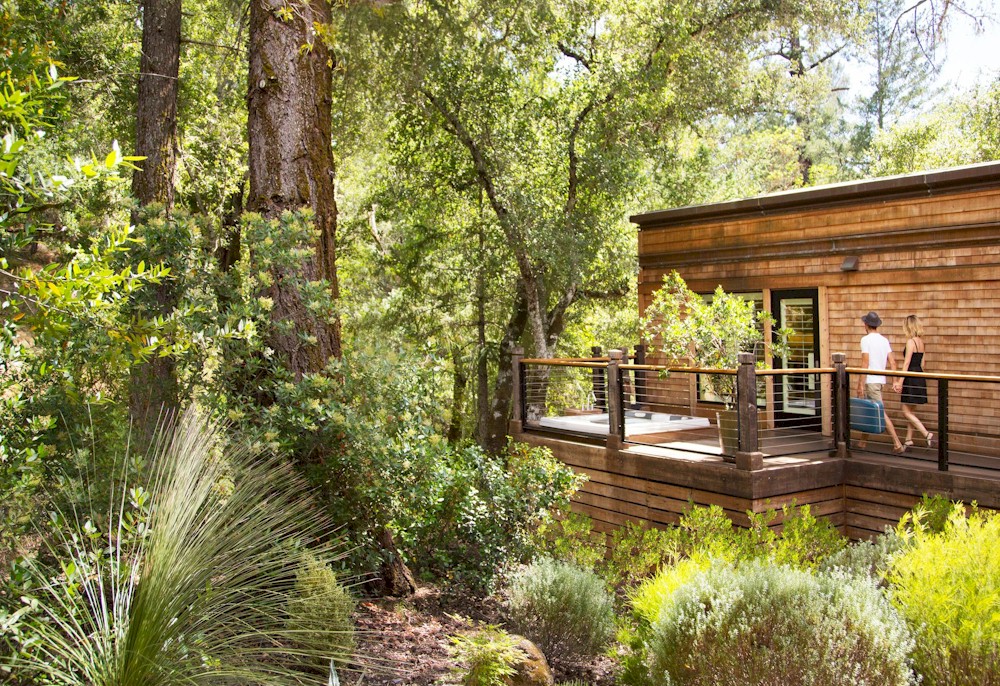
Over a decade ago, we embarked on the design of Calistoga Ranch, a resort tucked away in a secluded canyon on a 157-acre site marked by ancient oaks, majestic hills, a rock-hewn stream, and a private lake.
In creating this private luxury resort on one of the last available parcels in Napa Valley, our primary goal was to deliver a "bungalow in the woods" experience that immerses travelers in the beauty and tranquility of the natural environment.
As our firm continues to grow its practice, including the launch of a new studio called SB Outside that focuses on alternative, sustainability-driven hospitality units, we return to Calistoga Ranch as a seminal project, for despite being destroyed in the Glass Fire of 2020, it encompasses an early iteration of a "light-on-land" ethos.
The Calistoga Ranch site had long been zoned for camp-ground use, with a strict limit on stick-built construction, meaning limits on constructing buildings on-site. Today, prefabrication and modular construction are growing in demand as building processes with several environmentally friendly benefits. With its restrictions around stick-built construction, the Calistoga Ranch site demanded that we leverage such processes to bring the resort to life.
Rather than attempt to change the existing zoning, the development and design team worked within the existing guidelines and created each guest and owner lodge as a series of prefabricated modular units, set upon pier foundations and connected by wooden decks, trellised walkways, and large outdoor deck/living areas. The resort structures were clustered on 23 central acres (with the remaining acres undeveloped except for hiking trails) and placed so as not to disrupt the environment or necessitate the removal of trees.
By setting the resort structures on pilings rather than on traditional slab or perimeter foundations, the guest and owner lodges hovered above the landscape, allowing unrestrained root growth and natural drainage patterns within the sensitive valley setting. The unique series of structures for each lodge also allowed each unit to be more easily customized around existing topography, giving guests distinctive interactions with their immediate natural surroundings.
We proposed a similar elevated structure design that allows nature to remain as uninterrupted as possible for another hotel project in Utah.
"In developing the glamping tents and guestroom cabins at the Utah desert project, our team envisioned elevated cabin structures mounted on concrete piers and placed so that the slope of the earth can maintain its natural course," said SB Outside Director, Josh Abbey. "The cabins are elevated in such a way so as not to disturb water runoff and have a minimal impact on the landscape."
The above examples describe one aspect of a light-on-land approach to hotel design: honoring and safeguarding the patterns and intrinsic properties of the landscape. But in addition to being sensitive to the existing environment from a material and structural point of view, a light-on-land mindset considers building performance and asks how a hotel might be more self-sustainable in terms of mechanical, electrical, and plumbing (MEP) systems. Integrating rainwater collection and reuse for graywater systems, orienting buildings to harness and maximize natural light, leveraging natural ventilation systems and Passive House design methods are all key considerations when adopting a light-on-land approach to hotel design.
The cabins at the Utah Desert project, for example, were further developed to be of modular construction and self-sufficient, with off-grid capabilities such as solar panels, passive cooling, rainwater collection and filtration, and a local septic system.
At a project in Forestville, luxurious glamping structures are nestled in a site adjacent to the vineyards of Silver Oak Winery in the Alexander Valley of Sonoma County. We proposed a series of tents that settle gently onto the hillside and overlook the vineyards with views to the nearby mountain range. The residential scale arrival building acts as the central element of the overall development, with its upper floors housing three or four guestrooms for guests who might prefer more traditional lodging over a glamping experience out near the vineyards.
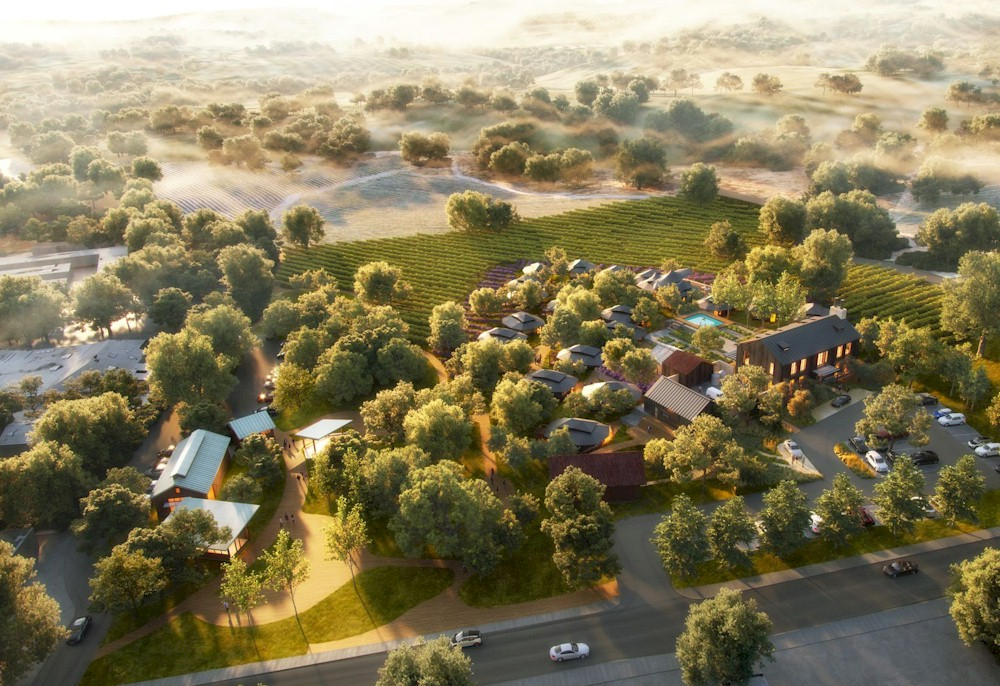
A forthcoming project in Forestville features a boutique hotel and elevated glamping tents that are positioned alongside vineyards and designed to deliver an immersive outdoor nature experience and meaningful interactions between guests and the local community.
Varying Levels of "Light-on-Land"
Today, more and more designers are working with developers to imagine concepts in which tented encampments or modular types of construction – where structures are created offsite, shipped, and erected on site quickly and with low impact to the natural environment – can be used for the entire development or as part of an overall project.
The latter allows you to concentrate more of the building footprint in terms of a permanent hotel structure in one location, while allowing the rest of your development to spread throughout the property in a less intrusive way. In the process of carving pathways and preserving the flora and fauna as you extend out from the central hub, you can minimize your hotel's overall impact.
Developers can consider different levels of "light-on-land" and determine to what extent a glamping component or alternative lodging experience can be added to a traditional resort development. An existing hotel can be connected to the city grid, for example, but a new glamping portion might only utilize the solar energy implemented within its own site. The goal of a "light-on-land" approach is not necessarily to be one hundred percent independent and carbon neutral or carbon negative, but to leave the lightest footprint possible and work with the resources that you have.
Not all hotel developments adopt a Passive House building standard to reduce energy consumption. The solution is largely contingent on location, as pointed out by Graeme Labe, Principal and Managing Director of one of the premier luxury tented camp and luxury lodge designers in the world, Luxury Frontiers: "In natural surroundings, what you want is in some ways counter-intuitive to Passive House design. For example, you want big windows to connect guests to the beauty of the natural environment, but Passive House design asks that you minimize the amount of glass and heat gain on your building."
Labe and his team are experts in high-end tented architecture in extraordinary natural settings. From the perspective of carbon footprint reduction, Labe notes that one of the worst things you can do is to attempt to air condition a single skin, considering that the properties of canvas have no insulation value. Luxury Frontiers is therefore exploring ways to move away from conditioned and toward bespoke spot cooling systems or Geothermal cooling and introducing elements of Passive House design into its designs. At times this entails giving the impression of a tent but maintaining the right kind of sustainable levels within the design. It is often a matter of balancing different layers to achieve the desired R values and level of sustainability.
Labe also explained that determining what might be a "light-on-land" structure is entirely dependent on context: "A rammed earth building is as "light-on-earth" in the right environment as a lightweight timber fabricated structure, because of how it treats ventilation and insulation. You would not leverage a rammed earth structure in a rainforest, but you could in an arid desert environment. This is where one looks to vernacular architecture for inspiration."
Ongoing Conversations Around New "Light-on-Land" Technologies, Materials and Systems
Key to a "light-on-land" design approach is selecting durable products and locally sourced materials that have minimal carbon impact. Using what is tried and true in the region has positive implications for the environment and for the guest experience. According to Ryan Clifton, Principal at the landscape architecture and land planning firm, EDSA, using a locally sourced material in different patterns and iterations can provide a rich, authentic experience that guests appreciate, leaving them with the impression that the hotel "was meant to be here."
However, it is important to ensure that what is around you is a renewable resource.
"Most vernacular structures are fairly sustainable; you just have to be careful that you are not cutting down forests and destroying the environment to build a resort," stated Labe.
As part of its mission to implement sustainable business practices, Luxury Frontiers is exploring the fastest growing plant on earth, bamboo, in its raw form, and natural bamboo architecture.
Luxury Frontiers has also been working to mitigate the use of concrete by tapping into the benefits of fabrics made with recycled plastics and treated with cementitious applications.
In revitalizing Puku Ridge in South Luangwa National Park in Zambia, which was comprised of a lodge and eight suites, Luxury Frontiers removed 2,420 tons of old cement slabs and repurposed materials to achieve a lighter footprint. In addition to incorporating bamboo – a conscious alternative to timber – in the floors and decking at Puku Ridge, Luxury Frontiers leveraged MatCrete – an enhanced fiber-cement blend that when used with FlexBond (a non-hazardous latex based liquid admixture for cement plasters), CemForce (woven polypropylene fiber) and CemLam (woven polypropylene fiber extrusion laminate) can form a reinforced, vapor-proof product. Locally sourced within South Africa, these materials are durable, recyclable, non-hazardous, low-maintenance, and better for the environment.
Adding two-story observation towers at Puku Ridge, one for each of the eight guest suites on site, Luxury Frontiers topped a mosquito-net enclosed bed atop each tower which sits under a shaded canopy and can slide out into the open air for an optimal star-gazing experience. The towers – built of lightweight timber on Zambian timber columns with carbon-neutral composite bamboo flooring indoors and out - were wrapped in waterproof woven fiber canvas, creating an almost mud-like look to mimic the appearance of a clay grain store found throughout the African bush.
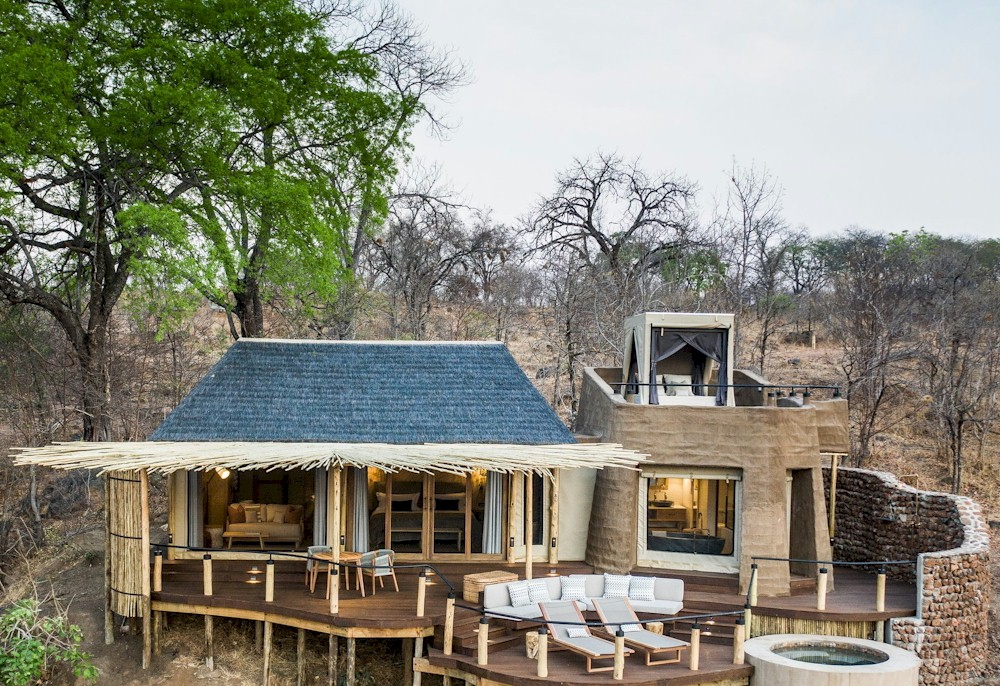
In re-vitalizing Puku Ridge, a renowned bush lodge in South Luangwa National Park in Zambia, Luxury Frontiers removed the original site's cement slabs and employed innovative, eco-friendly solutions and lightweight building materials to maintain the intimate bush experience of the lodge and its tented suites.
What's Driving the Demand for "Light-on-Land" Approach to Hotel Design?
A "light-on-land" approach to hotel design relates to two global trends:
First, sustainability has gone mainstream, and the need to address climate change is becoming more of a priority for developers and for travelers who want to minimize the impact on the environment. Whereas before, architects and designers may have been pushing for "light-on-land" design approaches, now there is greater and more widespread demand from developers amidst increased guest expectations for destinations with a harmonious relationship between building and site.
Second, hotel developers and brands are aiming to satiate travelers' thirst for the outdoors and nature experiences. Travelers are increasingly seeking the comforts of home and amenities of a luxury hotel amidst nature, and the alternative vacation – via treehouse stays, yurts, and glamping - is becoming more and more ingrained into hospitality.
These two drivers – the demand for sustainable travel-driven destinations and alternative stays immersed in nature – are not necessarily new, but they are accelerating as influences in the design and development world.
According to Luxury Frontiers, the movement of crafting engaging experiences and dissolving barriers between people and their environments formed in Africa, and in recent years has taken hold in the Americas, Asia, and the Middle East, with the urge to unplug and reconnect with nature driving demand. Many of the projects that Luxury Frontiers undertakes are in national parks, reserves, and areas that have stringent regulations associated with them. The exotic sanctuaries and protected areas where travelers want to have immersive, meaningful escapes often demand "light-on-land" approaches. In approaching these locales, designers must create a holistic sustainability framework before approaching any design.
"Before we go into conceptual design, we always consider context, and that context anchors the design," said Labe. "Within the context, you have historical influences, social and cultural influences, and the physical context, which are the climatic conditions, including the type of environment you are in – whether forest, desert, etc. – in addition to the topography of the landscape at hand."
According to EDSA, being physically immersive with a hotel site and understanding the topography of a place is key to being stewards of the land.
"By carefully considering movement and circulation, designers can curate the guest experience in a natural, not overly orchestrated way," explained Clifton. "Understanding the slopes, contours, and naturally occurring patterns of the land helps designers imagine ways that people might move from one space to another while experiencing all the sensual aspects of a place."
At Nekajui, a Ritz-Carlton Reserve, a forthcoming immersive resort and rare collection of residences in Costa Rica's Guanacaste Region, our team collaborated with EDSA on the planning, siting, and detailed design and Luxury Frontiers on the experiential lodging types, to create immersive experiences for guests in one of the rarest corners of the world. The exotic sanctuary is in Costa Rica's Área de Conservación Guanacaste (ACG), a UNESCO World Heritage Site. Honoring Costa Rica's position as a prime ecotourism destination and one of the most biodiverse countries in the world, the site-sensitive design weaves tree-house type structures and tents alongside villas, with a light-on-land approach that allows the design to be guided by the natural, steep contours of the land.
The planning began with an in-depth survey of every tree on the property and a development constraints map detailing nature's preservation, which informs the basis of the design. Heritage trees were protected and dictated where structures would be placed. Tagging significant trees can help ensure they are maintained or re-used and replanted when the remaining units have been built. One of the most significant challenges in preserving existing nature was working with a tremendously steep lot of land within Costa Rica. EDSA took painstaking care to locate the units alongside the hillside and create circulation amidst the pathways, carving out spaces as minimally as possible to prevent scarring the beauty of the hillside.
At Nekajui, designing with a "light-on-land" approach resulted in a project that winds organically from coastal bluffs down to the sandy beach, with a series of surprises for guests as they travel to and from destinations within the larger resort. A 150-foot-long pedestrian hanging rope bridge suspended over a 150-foot-deep tropical ravine teeming with wildlife offers incredible views of the ocean, and winding forest trails lead to tide pools, caves, and other points of interest to create memorable experiences for guests.
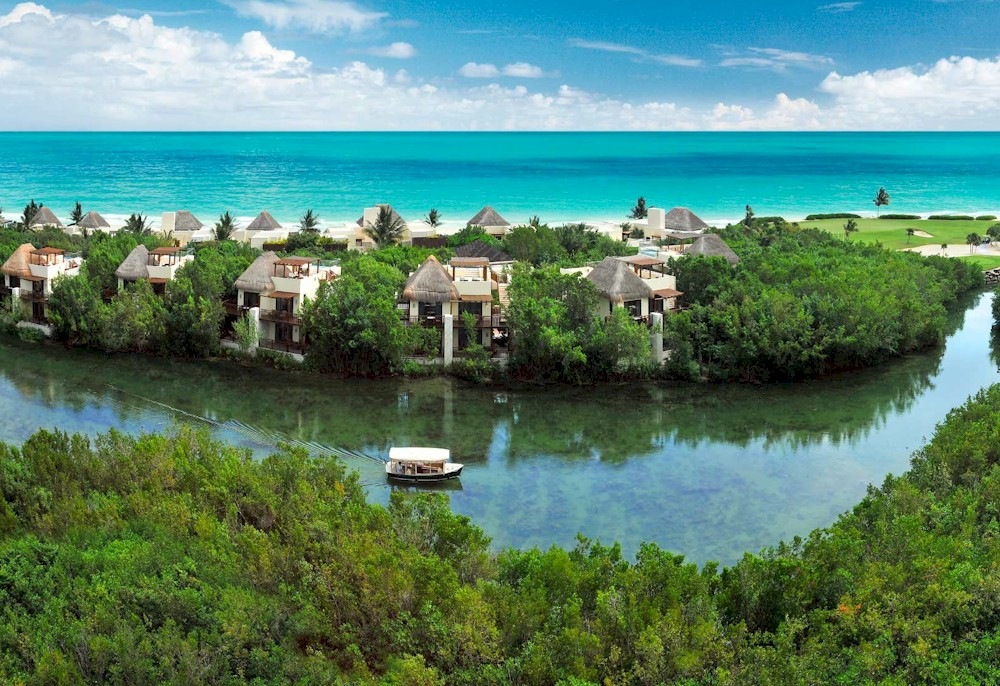
For the Mayacoba resort destination, which sits on 1,6000 acres of ecologically valued land, EDSA leveraged historically influenced design to expand the natural pattern cenotes in the region and create a 'village of water' by which distinguished hotels are linked by a unique system of connected canals and lagoons that serves to transport guests and offers new habitats for wildlife.
At another legacy project for EDSA, Mayakoba, located on the Yucatan Peninsula on Riviera Maya, the landscape architecture and land planning firm began master planning at a time when mega resort-oriented developments reigned in Riviera Maya. While most resorts had been stacked on top of each other, EDSA took a different approach in creating an authentic experience that celebrates the cultural, historical, and environmental richness of the region. The master plan for phase one created five ultra-luxurious hotel sites, a championship golf course, residential neighborhoods, and a system of freshwater lagoons and canals, with deliberatively placed architecture set amidst a mangrove jungle.
The site at Mayakoba was nontraditional in not delivering a typical beach resort; rather than getting as much of the hotel and guest experience right up to the beach environment, the development was situated a few hundred meters off the beach, with a mangrove preserve prefacing the beach experience. The environmental plan centered on expanding a natural pattern of cenotes – caves and tunnels formed by the erosion of limestone rocks – to create a connected system of canals and lagoons that would both improve the structure and quality of the mangrove forest and create an environment of discovery and authentic immersion for guests.
EDSA worked with local experts to map the existing, subterranean pools of water and to connect them to the surface in the most sensitive way. Native flora was carefully transplanted and grafted in special beds while a network of wooden walkways, narrow trails, and a series of lagoons accessible via water taxis, enable guests to explore the hotel while minimizing the human impact on the delicate ecology of the resort area.
Mayakoba's thoughtful design enabled a collection of highly reputable hotel brands to offer a range of unique guest experiences – from immersing in cenotes and traversing through a protected environment of mangroves to visiting a white sand beach – without requiring guests to leave the site, and while modeling ecologically responsible, historically-influenced design. The design acknowledged natural systems that were there prior to the development and ensured that manmade systems advanced, instead of detracting from nature. In addition to immersing guests in a celebration of Mayan culture, the design created a new habitat for wildlife and improved water quality through the unique aquatic ecosystem. Today, resort guests can explore, learn, and connect with nature with onsite biologists.
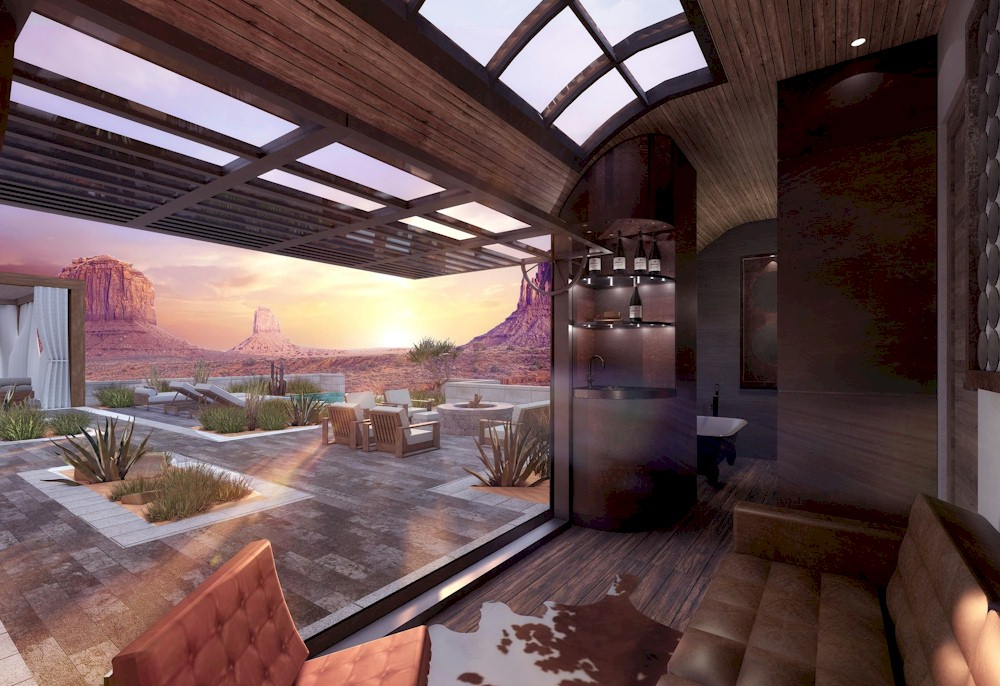
The Infinite Explorer concept imagines transforming existing infrastructure – in this case, the American West's defunct passenger rail lines – into conduits to one-of-a-kind hospitality experiences, with a train outfitted with luxury sleeper cars that open up and out, making stops along the route to immerse guests in wellness experiences and local excursions.
Acknowledging What Was There, and Giving Back
Today, travelers want to know that their hotel respects the environment, community, and people who engage with it. The COVID-19 pandemic helped expedite that trend; not just the appreciation of being in nature, but the appreciation of connecting with the local community and being a part of it. The new era of "light-on-land" approaches to hotel design expands the sustainability mindset to consider ways our designs can help sustain a local community and help preserve its history, traditions, and customs.
For the Forestville project, which sits adjacent to old vineyards, our proposal was for our team to help restore or maintain the vineyard and integrate a wine experience into the guest experience. Our designs are driven by a quest to place a guest in a new environment and teach them about the local customs and personality of the place. One way to achieve this is through local farm-to-table experiences. Our Forestville project design envisions a tasting room and a restaurant component that is community connected and run by an independent restaurant entrepreneur who is local to the area. Guests are encouraged to explore the local community by leaving their cars upon arrival and using branded bikes that will allow guests to travel the scenic wine country lanes and around downtown. A portion of the land on which the project sits will also be donated back to the community as a park.
EDSA approached Rosewood Castiglion del Bosco, an iconic resort located in Tuscany, Italy, with a similar goal of enhancing a site and finding new ways for people to experience it. With a focus on the land, wine, and people of the region, EDSA's design reimagined a once 800-year-old estate into a restored property featuring the estate castle, a medieval church, and the Borgo, a traditional Tuscan village that forms the heart of the resort with a 23-suite boutique hotel. The estate is now a living community dedicated to the celebration of Tuscan food, wine, and culture, with two restaurants, a culinary school, an organic kitchen garden whose vegetables, fruits, and herbs are used in the restaurants and culinary school, and a spa.
In approaching the Borgo and surrounding vineyard, EDSA conducted on the ground research and detailed analysis, noting opportunities for restorative native plantings and revegetation to return the site to a state that would be hospitality worthy. All site improvements were approached through a lens of 'low impact design' and with sensitivity to history and regional traditions, from respecting early hydrology systems to reusing existing building footings and using original materials for all roads and hardscape areas.
EDSA focused on increasing awareness of cultural and environmental heritage in the region, maintaining and repurposing existing buildings – including the transformation of 17th and 18th-century farmhouses into villas – and embarking on a preservation effort in terms of enhancing the vineyards and preserving 100% of the site's existing mature forest, with a quest to give back to nature. A series of trail systems running through the site allows guests to experience the nature preserve, which has the distinction of being a UNESCO World Heritage Site.
For the Radical Innovation 2019 Awards, our team proposed a concept that leverages existing infrastructure as a conduit to immersive nature, adventure, and wellness experiences, called Infinite Explorer. Many railways that were once bustling with excitement are now dormant and forgotten, providing little footing for hospitality development despite spanning untapped, truly breathtaking, locations. Seeing potential in what seemed a lost cause, we created a hospitality concept to transform the existing infrastructure of these underutilized spaces and make the unreachable, reachable.
The Infinite Explorer concept entails a train with cabins designed to open at a variety of stops with newly created, light-on- land, outdoor infrastructure, allowing passengers to step from their cabin at stops along the route to enjoy the region's incredible natural scenery along with an immersive program of activity. The outdoor adventures, wellness, and dining experiences conceived as part of the program would draw on the talent and expertise of locals in each region and support local economies.
SB Outside will bear traces of this concept as we continue to drive forward adventure-driven environments that uphold a close connection to the land. As designers and architects, we have a responsibility to help drive the "light-on-land" revolution and spark curiosity and interest in implementing sustainable systems for hotel design. It's not just a matter of working as closely with the local climate and ecology as possible and considering the potential physical impacts of a design, but also being mindful of how that design will relate to the surrounding community. How can hotels be built sustainably in the sense of educating the guests about what came before, and immersing them in the local culture through authentic community engagement? We are excited to explore this question in the future alongside design leaders like EDSA and Luxury Frontiers.
Main image: Calistoga Ranch, CA