





Social Media Marketing Strategies That Impact Hotels in 2022
By Gaurav Varma






Frequent technological leaps, an extensive repository of buyer data, and billions of active users make social media an essential tool to establish your brand voice. Not only does it expand your reach, but in our current digital landscape, social media influences purchase decisions throughout the buyer journey.
Having a social media presence can't be ignored as a statement factor for businesses anymore. Hospitality and travel, the fastest growing industries of the new millennia, can undoubtedly benefit from its unlimited potential.
Social Media Marketing in 2021 - Key Benchmark Statistics for Travel & Hospitality
With over 4.5 billion active users in 2021, social media remains the top engagement platform across industries. A channel where half of the world population is spending an average of 15% of their day, social media has far-reaching commercial opportunities.
The experiential factor of travel makes it a common topic of conversation on highly personalized social media feeds across platforms. The rise of travel-related communities, higher shares of social traffic on organic searches, and a phenomenal jump in social subscriptions post-2020 indicate that social media marketing has laid a firm grip on global hospitality markets. And the trend is not going away anytime soon.
What Worked for Travel on Social Media in 2021?
- 97% of millennials share photos on social media during travels
- 90% of Facebook's ad revenues ($55 bn, annually) comes from mobile ads
- 85% of travelers book their trips on mobile devices
- 74% of travelers use social media while on vacation
- 79% more engagement is generated for posts with location tags
- 71% of travel agencies report better interactions with consumers when committed to a social media strategy
- Women do 66% of travel bookings
- 52% of Facebook users are inspired by families' or friends' photos before booking a trip
- 51% of people on Booking.com wanted to visit destinations untouched by their friend circle
From awareness to consideration to decision, social media influences all levels of the hotel booker's journey. Social media will significantly align users' expectations with your business objectives as the world migrates further to digital.
Social Media's Importance for Hotels in 2022
Personal profiles, groups, forums, and chat rooms are flooded with customer and traveler reviews, ratings, inputs, and updates on destinations and local tourism. Consumers use social media vehemently while planning as well as traveling.
As the world continues to adapt to a new level of digital inclusiveness, hotels and resorts are seeing the benefits of social media in marketing. It is the best reach and engagement tool in the hospitality industry.
ADVANTAGE | Why Add Social Media to Your Hotel Marketing Strategies?
With their high number of active monthly users, social media platforms are the one-stop shop to expand your brand's reach, visibility, and engagement. Interacting with users regularly on a more familiar platform boosts your brand image and builds authority. Popularity on social media indirectly translates to higher bookings and revenue.
Greater Visibility: The targeted social media algorithms automatically make you visible to the most relevant users. You can configure your post boosts to enhance this targeting further. Images, location, and hashtags are helpful tools in making your content more search friendly.
Increased Reach: Social platforms are where most audiences already are compared to your website, where you need to drive traffic to. With the right targeting strategy, you can penetrate your current audience cluster or expand your reach to new user groups.
Higher Engagement: Social media inspires free communications and is the best medium to engage with your audience. travel is one of the most talked-about topics amongst social users, and your brand has the potential to become the ice-breaker.
More Conversions: Many travelers receive recommendations from friends and families through their social profiles. A well-maintained hospitality brand has higher chances of converting here than from a saturated Search Engine Results Page (SERP).
Better Authority: Social media platforms have adapted to the ratings-and-reviews system for local brands. Your follower strength and positive reviews on social media speak volumes about your property and attract relevant users. Facebook's recent "Recommend" feature can be a direct indicator to measure guest satisfaction.
While your hotel's Facebook page can be an easy tool to boost brand authority, you also have to be ready for backlashes from disgruntled users or consumers. On the positive side, your onsite team gets real-time inputs on issues and can be prepared to provide resolutions on the spot.
AWARENESS | What Does Poor Social Media Presence Mean for Your Hotel?
Tourism and hospitality are service-oriented industries that thrive in personalized experiences, and social channels are a highly customized medium driven by user behavior. They complement each other, and your hotel marketing mix's failure to adopt social media loses your brand a natural ally.
Apart from missing out on a targeted engagement tool and relevant traffic source, you also miss out on opportunities unique to social media platforms.
- Users trust social media for travel recommendations. They are already motivated by seeing their friends, families, and idols traveling to exotic locations. The window of opportunity is small, and a hotel with a good social media presence is far more likely to gain from that than those who don't.
- Users are expecting to communicate on social media. Due to its personalized nature, users are looking to build a human connection on social media. They will not be as guarded or opposed to a well-packaged commercial message that appeals to their traveling needs.
- Social media is a steady source of brand advocators. People will share good content irrespective of visiting your location or being physically in touch with your business. You are piggybacking social media users' follower-base to expand your brand reach exponentially.
- Social media levels the playing field. Users judge content, and how the user feels is often the final say on social media. Everyone gets to present their value – from big-ticket hospitality brands to local tourism operators. This also gives businesses the freedom to think about their brands creatively.
- Social media presents the chance to go viral with your content. Popular platforms like Facebook and Twitter currently engage billions of monthly active users. With enough users sharing and engaging with your posts, your brand can become the next internet sensation.
- Social media thrives on nostalgia. Repurposing content becomes mainstream, with new post formats frequently included on social channels. There are tons of fresh perspectives to look at your legacy content. Concepts like Stories, Memories, Reels, etc., contribute to brand recall and let users relive their best engagements with your brand.
ADOPTION | How Many Hotels Are Actually Doing Social Media Marketing?
Social media is increasingly gaining popularity amongst hospitality brands to drive guest engagement and direct bookings. Post-2020, it has also emerged as a key sales and marketing priority. But even after such aggressive leaps, the primary adoption percentage of social media in the hospitality industry remains at only 48% globally.
Challenges of social media adoption in hospitality:
- Leading hospitality brands still have resistance to adopting the latest web technologies.
- External pressures dictate social adoption. Lack of awareness and internalization of social best practices results in skill gaps, impacting performance.
- Social media is still evolving as a business tool, causing further mistrust amongst adopters.
Top 5 Social Media Marketing Trends for Your Hotels in 2022
Social media has evolved from a casual communication medium to a complex ecosphere where individuals, groups, and businesses collaborate and influence each other. In the past two years, we have become more dependent on social media for emotional, psychological, and practical solutions. Our perception regarding brands on the platforms and how we interact with them have changed. By studying the emerging trends, marketers can position their brand better in the new world order.
1. User Needs Are Changing. Brand Messaging Will Have to Follow Suit.
Users feel the need to connect more than ever. Interacting with warmth and authenticity will humanize your brand and make it more tangible and relatable to your audience. To sound genuine, you also need to know what users need from you. You need to re-check your audience's pulse before going on a campaign spree.
Cause-driven Content: 75% of social users expect brands to commit to causes that matter to them. This scenario has emerged, especially after the traumatic experiences of 2020. Brands that value social impact and support issues like sustainability and diversity through their services or messaging will have an advantage in 2022.
Celebration-driven Travel: Many life events like anniversaries, birthdays, weddings, special festivities have been missed in the last two years. 2022 will be the year where people will want to redeem their travel plans. As frantic travelers look for ideas on social media, your brand must be a part of these conversations.
Wellness-driven Destinations: Travelers are looking for wellness alternatives outside the comfort of home. Destinations that connect guests with nature while maintaining social distancing will be on the top of their list. Onsite wellness offerings like exotic yoga routines, sound baths, etc., will influence purchase decisions.
Location-driven Campaigns: Local targeting is your best bet to maximize relevant audience reach with high RoI this year. Hospitality brands are using geo-tagged posts to attract relevant users to local attractions. Enhanced paid promotions of Facebook, Twitter, and Instagram enable your brand to focus your campaign budgets on locations of your choice.
2. Videos Will Drive the Future of Social Media Marketing
Social media has progressed far ahead since the days of simple image posts. Video content has ruled the social marketing domain for a few years now. It keeps users hooked on the screen, adding a new avenue to monitor user behaviors. Users are more engaged with shorter video formats on social channels to further retain attention. Immersive content has also become a more mainstream feature since 2020.
Live Videos: As social media algorithms restrict a brand's entry to personal feeds, live videos are a great way to interact with willing users and gain their attention. 82% of the audience on social media prefer live videos over curated video content.
Short-form Videos: Short-form videos propelled to fame during the pandemic. Platforms like Tiktok led the charge. More mainstream media like Instagram, YouTube, Snapchat joined the trend later in 2021 with their versions.
Stories: Ephemeral content, or "Stories," are new to social media posts. While your posts take permanent space on your feed, Stories disappear, and you can build anticipations afresh. Apart from live videos, Stories are a great space to make brand announcements.
AR/VR Experiences: Giving a virtual tour of your hotel or amenities has become a standard feature post-2020. Hospitality brands will continue to invest more in Augmented Reality (AR) and Virtual Reality (VR) to increase engagement on social platforms.
3. User-Generated Content Will Have More Control in Brand Advocacy
Social media algorithms are designed to protect user rights. With the world governing bodies recognizing these platforms' influence on mass behavior, data protection laws will become more robust, giving users more control over what they want to see.
That being said, there is a unique opportunity for travel businesses to promote their brand through user-generated content (UGC). Many brands promote UGC as part of their brand promotions as proof of the quality of services. There are four distinct advantages of that:
- While validating your brand with user remarks, users feel valued for honoring their opinions.
- Promoting UGC gains your brand trust amongst the growing social media communities.
- Displaying UGC cuts marketing budgets on branded content.
- Boosting UGC encourages more users to contribute.
You can create a social media community of your own where loyal followers can interact. This can be a safe space for them to air their feedbacks and grievances as well as for you to receive them.
4. The Influencer Marketing Spectrum Will Broaden in 2022
The trend of influencer marketing has seen a revival post-2020. The partnership between travel marketers and influencers has seen a shift in dynamic. Social influencers can't rely on just selfies and live appearances to engage the brand they endorse. They are expected to go the extra mile – following social media best practices to create and promote branded content amongst their loyal followers. Marketers continuously look for genuine individuals who have engaged communities locally and presented real value and RoI to the brands.
Micro-Influencers: Their follower count is generally less but more focused, loyal to a fault, and an excellent choice when you want to create a loyal follower base from scratch. Close collaborations are necessary, but they promise impressive results once successfully penetrated.
Omni-Influencers: These influencers are valuable to build a community of loyal users across channels. They have nurtured communities on more than one platform, and their voice can boost your brand awareness and conversions rapidly and seamlessly. Their broad influence can cost higher than micro-influencers.
5. Social Media Platforms Are Becoming More Independent and Conversion-Friendly
For so long social media platforms have played a supporting role in business conversions. Major channels like Facebook, Instagram, and WhatsApp populate their platforms with business features to reshape the buyer experience.
Social Commerce: End-to-end purchases are now possible on social media because of in-app shopping integrations. Using social groups and direct messaging to plan trips will empower brands to facilitate this function.
Social Chatbots: Break the customer service queue with AI-powered social chatbots. Hospitality brands can reduce their "respond to messages" time with chatbots and increase customer ratings.
Planning Your Social Media Marketing in 2022
Your social media marketing plan should start by identifying your business goals. There is no generic formula for all businesses, and hospitality brands can efficiently utilize social media platforms' unlimited potential to resolve a few common marketing goals.
- Identify your audience and their favorite social media channel
- Build a rapport with current and potential guests
- Create a brand voice that speaks for your audience demographic
- Acquire real-time data on the market, business, and audience needs
- Optimize marketing promotions and advertisements for the best impact
Execute Your Social Media Marketing Plan!
If 2021 was the year to break the quarantine, 2022 will look towards travel normalcy. People have become more digitally aware in the last two years, and it will take more than a cute hotel website to reel in the big fish. Social media marketing will provide you with a competitive edge in a more user-controlled hospitality market.
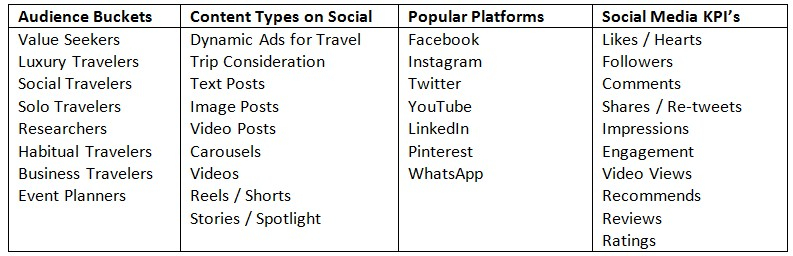
Below is the checklist to get your hotel social marketing plans rolling!
References:
- MDPI – Research Article | Organizational Adoption of Social Media in the Hospitality Industry: An Integrated Approach Based on DIT and TOE Frameworks
- Influencer Marketing Hub – Article | The State of Influencer Marketing 2021: Benchmark Report
- Siteminder – Article | Hotel Marketing in 2022: The complete guide
- DataReportal – Article | Global Social Media Stats
- Stan Ventures – Blog | 11 Latest Social Media Trends That You Should You Follow in 2022
- PhocusWire – Blog | Social Media in 2021: The New MVP for Hospitality
- Travel Tractions Marketing – Blog | Social Media Marketing for Hotels – A guide for 2021
- SocialTables – Blog | 10 Common Mistakes in a Hotel Social Media Strategy
- HospitalityNet – Blog | Social Media for Hotels – is it worth it?