






Design Strategies to Promote Wellness in Urban Hotel Environments
By Scott Lee






The layout and organization of spaces, outdoor access, visual appeal, and lighting all have a tremendous influence on people's mood and frame of mind. The emotional fallout of the COVID-19 pandemic has heightened our focus on mental health and well-being as designers.
There has been a shift, not necessarily away from physical wellness, but rather in looking at how people feel – calm, reassured, and connected or stressed and out of sync? – and considering both the psychological and physiological impacts of the built environment.
While we might associate wellness with travel experiences in far-flung locales - where retreats are tucked away in the mountains or beachside - urban destinations challenge us to think creatively about how to design escapes in the heart of metropolitan cities with wellness-supportive elements.
Despite widespread prognoses about the death of cities due to remote work and people leaving urban centers for more space and greenery, the enduring appeal of urban life and travel is undeniable. Prior to the pandemic, the urban resort concept was on the rise, with brands like Aman and Six Senses embracing the model as part of their growth strategy, and the trend will continue to grow, especially with the lines between work and leisure blurring and increased desires to take a break from the grind and enjoy urban adventures and cultural exploration.
By tapping into sensibilities that we might leverage in a horizontal resort environment, and applying them to an urban context, we can create spaces where people can "get away from it all" while remaining in the middle of it. Urban resorts deliver immersive experiences through rooftop experiences and iconic, place-defining food and beverage, and although in urban settings, they prioritize connections to nature, seamless transitions between indoor and outdoor spaces, natural light, and, of course, guests' health and wellness.
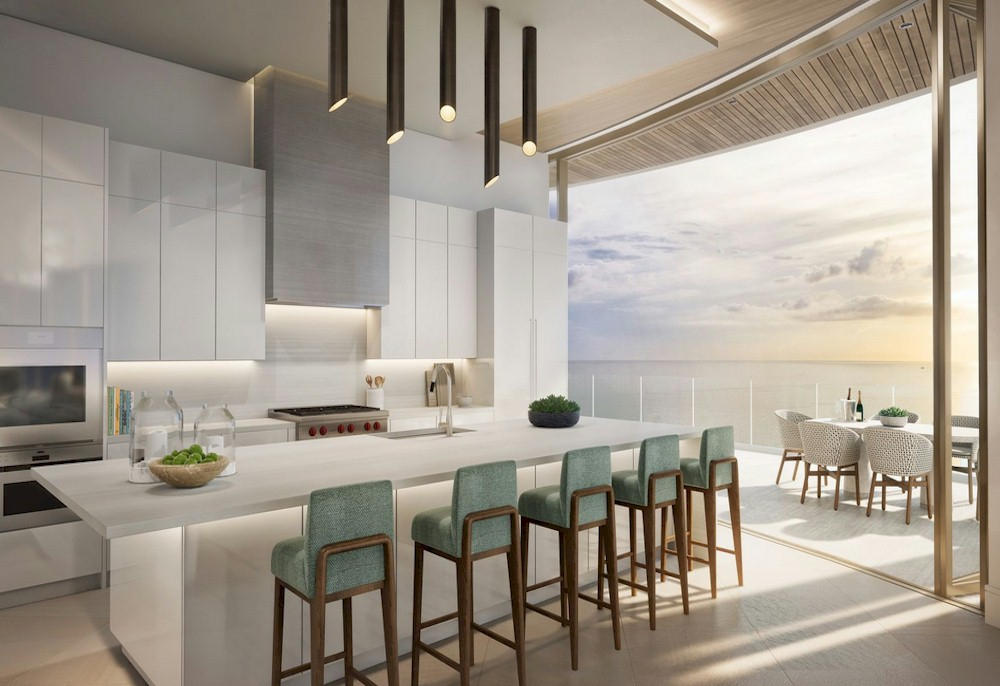
Whether in a dense, urban hotel environment or surrounded by natural settings, creating seamless transitions between indoor and outdoor spaces with floor-to-ceiling glass windows and extending the interior ceiling straight out into the architectural ceiling can create the sensation of being outside, with positive implications for lowering stress levels and enhancing mental clarity.
Harkening Back to a Pastoral Past and Creating Meaning Through Thoughtful Materiality
Facilitating connections to nature is key to creating a sense of emotional and mental well-being in hospitality environments, but in urban hotel environments, where there is less immediate access to green space, thinking outside the box is a must. At an urban resort in Sunnyvale, we created an immersive, regenerative experience by tapping into the agricultural past of the locale.
Bringing the agrarian history of Silicon Valley to the forefront of the experience, we took an architectural vocabulary grounded in the size, scale, and pedestrian nature one might expect in a Napa Valley retreat, to a region renowned for its busy streets and booming tech scene. We also locally sourced rustic materials that will age gracefully, to authentically connect the guest to the place and its past.
We can remove part of the anonymity of the urban experience – where big buildings with nameless and faceless corridors can feel soulless – by attaching meaning to otherwise anonymous elements. Salvaged materials can elicit positive psychological responses for carrying vestiges of the past, just as natural phenomena like marine terraces carry traces of their formation hundreds of thousands of years ago in wave-cut surfaces. When reclaimed wood or another salvaged material is woven into an urban hotel environment, not only does it aid the environment by keeping products out of landfills, but it also carries a timestamp and story that deepens the guest experience.
1 Hotel Central Park, for example, where the building exterior is covered in ivy, features natural materials in their raw form, including woods and textiles with original markings, veining, knots, and color variations. These materials celebrate difference and "imperfections" in what otherwise might feel like an artificial, overly manufactured environment. Reclaimed redwood timbers from decommissioned New York City water towers were also branded with their source and integrated in the 1 Hotel Central Park's design as headboards.
Such materials contribute to the wellness experience by bringing the outside in, and by indicating that beauty and relevance remain despite these materials being "past their prime." If these materials can age gracefully, so might we; this sentiment brings peace of mind and might be considered when selecting materials in urban hotel environments.
Choreographed Journeys Designed to Help Guests Decompress
The aforementioned Sunnyvale project adds a wellness element to its urban context with a more gradual arrival experience that serves as a prologue to a series of curated experiences that unfold as you move through the property. In contrast to a heavily fortified, purely vertical configuration built right up to the property line, our team created a choreographed procession that creates a sense of escapism from the tech fabric of Silicon Valley. Rather than arriving in a standard hotel lobby, guests are greeted in an arrival pavilion with an unexpected whimsical twist, thus setting the stage for moments throughout the site that are meant to surprise and delight.
"The arrival sequence is meant as a decompression zone, instantly transporting the guest to the simpler times of a bygone era through a series of building and landscape follies," said SB Architects Vice President and Associate Principal, Matt Page. "Guests enter a motor court and encounter a beautiful heritage oak at its center, with hanging lights that will be particularly amazing at night."
As you leave the hustle and bustle and concrete jungle of Silicon Valley and enter the motor court at this urban resort, you discover you are in a different place – maybe even a different time, within an intimate and relaxed agrarian environment that was prevalent in Sunnyvale prior to WWII.
At St. Regis Longboat Key Resort and Residences, a forthcoming resort community that we are designing on a barrier island outside of Florida, our design partner HBA Miami created portals into nature with the resort interiors, featuring an immersive, barrel-vaulted digital ceiling in the entry corridor where ambient lighting reflects the brilliant colors of the sunset. The corridor serves to calm and transport guests into a peaceful environment, as projectors display birds in flight across the ceiling, bringing the outdoor environment inside.
One of our other interior design partners, BAMO, leverages transition chambers to create "decompression zones" in residential projects, a technique that can be applied to the urban hotel environment if the guestroom is spacious enough. Transition chambers, or smaller, darker spaces that feel more intimate and protected, can reset your frame of mind and signal that you are departing one world and ready to experience another.
"Urban hotel designers can leverage such spaces to make guests more receptive to seeing something new," said BAMO Principal Anne Wilkinson. "Transition chambers serve to heighten the senses, allowing you to take in more information versus it being all a blur."
This desired effect is not dissimilar to the "relaxed attention" that yoga practitioners strive for. In Savasana, the final resting pose in yoga, the idea is to slowly relax one part of the body at a time, soaking up the benefits of the active poses that opened, lengthened, and released tightness and tension in the body. Creating a sense of "active stillness," the resting pose is not necessarily for zoning out – although it's certainly tempting to fall asleep - but rather to relax and become more aware of the body, breath, and mind. Rather than abruptly ending the active poses, rolling up your yoga mat and departing, you transition into another stage before re-entering the world.
The prioritization of periods to "reset" the body and nervous system is evident in a relatively new urban hotel environment, Equinox Hotel Hudson Yards, in New York. With a very urban sensibility, Equinox' first entree into hospitality is built around the concept of "high-performance living," and seeks to maximize guests' cognitive and physical abilities by leveraging the latest innovations in technology.
As a core component of the hotel's full integration of fitness, health, and mind and body wellness, the spa experience and its technology driven therapies are conduits for training the mind and body, representing a paradigm shift for the spa category. A private infrared sauna isn't a passive treatment designed for relaxation; instead, far-spectrum wavelengths penetrate the body and warm it from the inside, accelerating muscle repair and rejuvenating cells.
Enlisted to activate the space and craft the spa program at Equinox Hotel Hudson Yards, the globally recognized spa design and consulting firm TLEE Spas oriented the spa experience toward peak performance balanced by recovery, restoration, and regeneration. In addition to an infrared sauna, spa guests enjoy direct views of the Hudson River and have access to cryotherapy, an indoor saltwater lap pool, hot and cold plunges, and private relaxation cabins.
These E.Scape pods include private meditation sessions incorporating an intelligent audio library and EEG data, developed with sleep scientists, to help manage guests' stress and help them decompress. Guests can supplement the E.Scape experience with "add on amplifiers" such as targeted light therapy sessions that deliver health benefits, not just cosmetic benefits, promoting cellular healing and stimulating collagen production and pain reduction.
One innovation in the spa menu is quantum harmonics, a sound therapy session designed to train the brain to relax through acoustic and vibrational therapy. Included as part of a circuit involving cryotherapy and infrared treatments, a session centered around a Wave Table delivers sound and vibrational therapy to help guests wind down and stimulate rest phases in the brain, so the relaxed body doesn't have to compete with a mind that is racing.
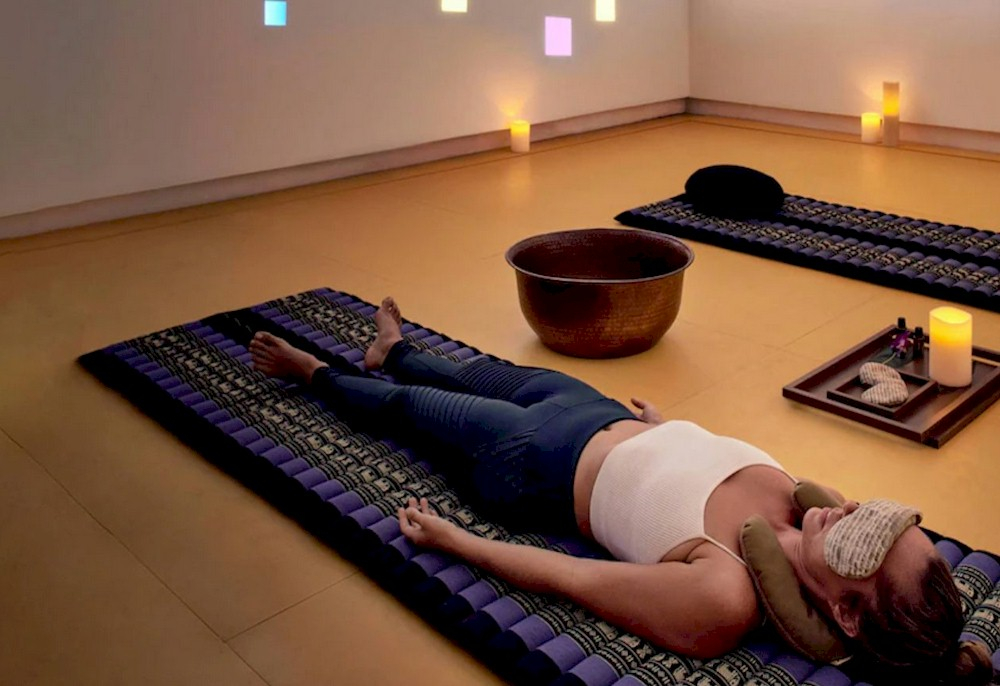
To ease guests' transition from their Spa Alkemia experience back out into the world, TLEE Spas created a room for guests to soak up all the benefits of their treatment while lying on the ground and receiving the physical vibration of music while their brain absorbs the acoustical aspects.
"TLEE Spas created a "Savasana Sound Room" at Spa Alkemia at Zadun, a Ritz Carlton Reserve in San Jose del Cabo, Mexico, that carries the same principle as the Wave Table, but in this case, the whole room is dedicated to sound therapy where the benefits of acoustic and vibrational therapy resonate from the floor and walls and resonate through the entire body. "This creates a meaningful post-treatment experience," explained Vice President and Chief Operating Officer of TLEE Spas, Michael Lahm. "Partnering with SO Sound out of Colorado, we created just as intentional a sequence in the departure as in arrival, to maximize the benefits of the experience."
Related to this idea of creating intentional sequences and punctuating hotel stays and spa experiences with impactful, small moments, is creating a prelude to the hotel itself, a design strategy that can break down the seriousness of the urban hotel and make it approachable, casual, and familiar.
The Myst Dong Khoi, for example, is in Ho Chi Minh City, a very populous city where tall buildings, scooters, motorcycles, cars, and people create a frenetic environment, yet the hotel's outdoor cafe is designed to greet guests even before they arrive at the lobby, creating a peaceful and welcoming vibe. The lobby itself is adorned with artifacts, industrial parts, and scraps salvaged from the 200-year-old Ba Son Shipyard across the river, making the space a cultural destination unto itself.
The Myst Dong Khoi departs from what you might expect an urban hotel to be in its eclectic materials, textures, and façade. When you arrive at your room, you discover an outdoor shower on the terrace, and a variety of tropical flora growing to partially obscure city views for privacy. The hotel façade is composed of irregularly shaped windows unevenly spaced and featuring plants of different sizes and shapes.
Colin Ellard, an environmental psychological and neuroscientist who researches the psychological impact of design at the University of Waterloo in Canada, found that building facades play an especially important role in impacting people's psychological state, positively impacting people if complex and intriguing, and creating a negative response if simple and monotonous.
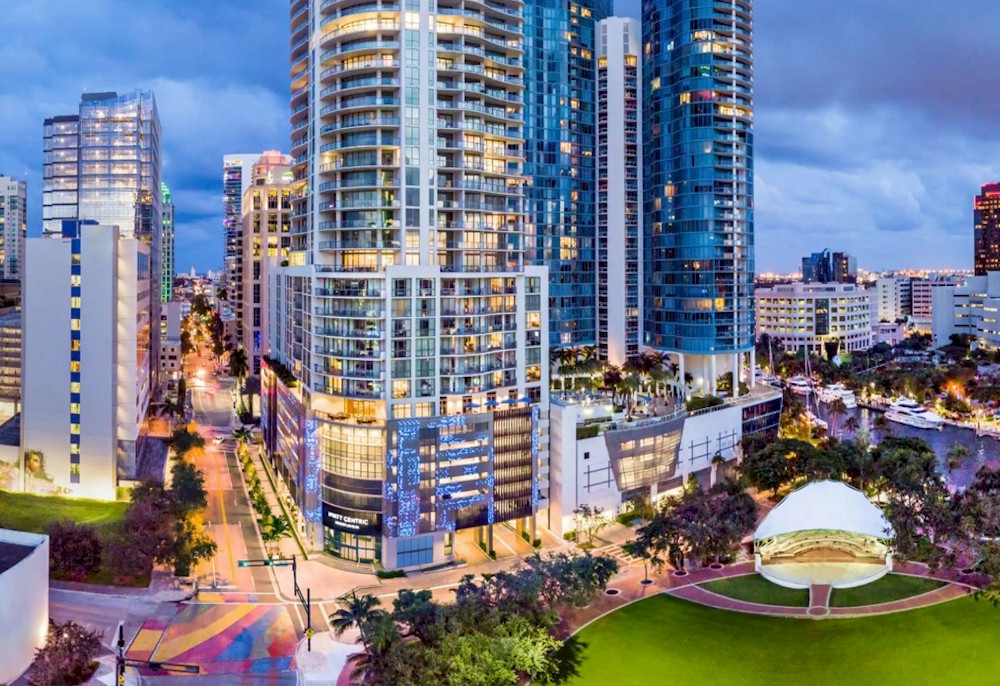
Sameness in color, material, and surface can negatively impact our mood and mindset before even entering a building. For 100 Las Olas, a 45-story high rise whose luxury residences, hotel guest rooms, fine dining and select retail comprise the tallest building in Fort Lauderdale, SB Architects sought to balance a dense urban area with design that creates contrasting feelings of light and expansiveness, expressed in curved geometric shapes wrapped in steel and glass.
The tower embraces the round element of the corner on which it sits with subtle curves, creating a softer, water-like counterpart to urban areas dominated by hard surfaces and straight edges. The design also allows light to dance across surfaces and reveals long city views from private terraces with glass balconies. While it is not a beachfront building, its position on Las Olas, Spanish for "waves," is echoed in the building's design, creating a uniquely serene source of luxury within a bustling downtown.
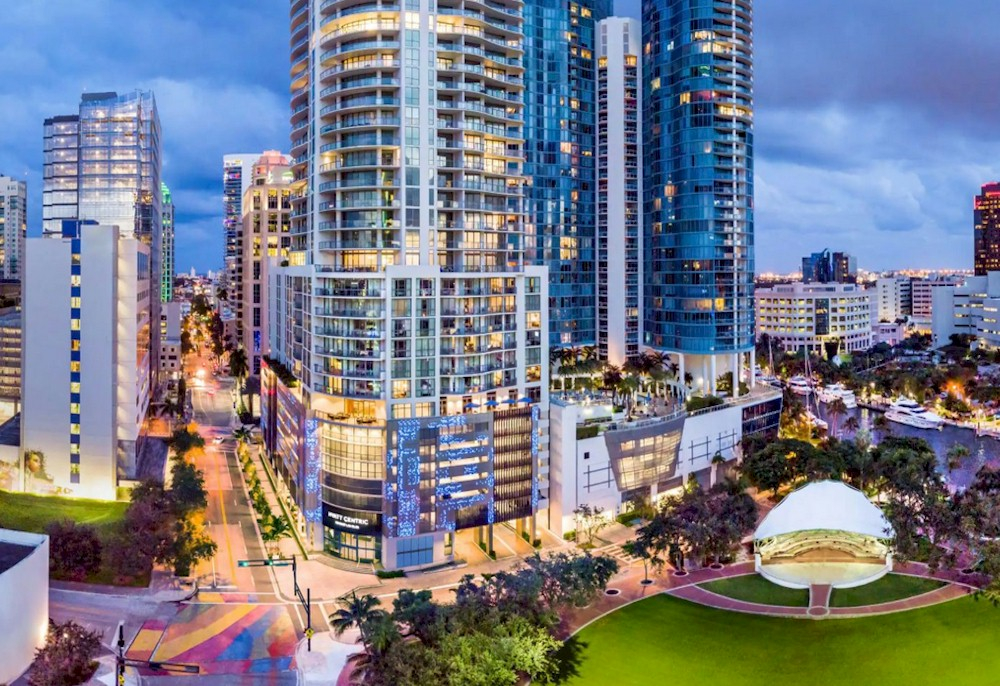
The 45-story luxury hotel and residential high rise 100 Las Olas features unique, curved geometric shapes that are friendly to light and wrapped in steel and glass, offering urban dwellers and visitors a refreshing departure from concrete-clad buildings.
There are other ways to add dynamism to a building's façade and add an element of gracefulness to the arrival experience at an urban hotel. At The Joule Dallas, the lobby is designed with a "prelude" that defies expectation and encourages connection. Instead of walking into the lobby for a spiritless check-in experience, guests discover the entire downstairs experience is woven into the fabric of the city; the community is there mingling with guests amidst retail and restaurants inspired by Dallas itself.
On the 10th Floor, a pool cantilevers eight feet out over the ground below. While the entire pool area is an oasis in delightful contrast to the surrounding buildings in the heart of Dallas' central business district, the pool design gives swimmers the exhilarating sensation of floating off the building's edge.
The glass-fronted pool feature is akin to integrating floor-to-ceiling windows to draw in more natural light and enhance views. At St. Regis Longboat Key Resort and Residences, SB Architects underscored connections to the unique environment through contemporary buildings comprised mostly of glass, featuring clean lines and floor-to-ceiling windows. Resort guestrooms and luxury residences offer unobstructed views of the Gulf of Mexico with frameless glass railings.
BAMO leverages this technique in its interior design practice to create seamless connections between inside and outside.
"Wherever we can, we leverage floor-to-ceiling windows, so the eye has a seamless view," said Wilkinson. "By extending the interior ceiling straight out into the architectural ceiling, you can blur the lines between interior and exterior spaces, making it appear to guests as if they are outside because their eyes don't have a stopping point or dividing line. This is especially important now, when people are gravitating toward being outside and associating outdoors with a feeling of safety."
Creating Uplifting Sensations and Reassurance with Interiors and Lighting
Not only do we associate the outdoors with a feeling of safety, but we also know that access to daylight and views is important to triggering biochemical reactions in the brain, improving cognitive function, and boosting mood. More new builds will call for giving people the ability to get outside and enjoy more of an indoor/outdoor experience. Where there are fewer opportunities to get outside, designers can open up the view to engage people with the landscape or sky.
BAMO is currently working on the interiors for Waldorf Astoria Miami, the tallest residential and hotel tower south of New York City, designed by Sieger Suarez Architects in collaboration with Carlos Ott. The project was envisioned as a unique, freestanding sculpture within the sky, comprised of nine spiraling, offset cubes. The cube-style architecture – by which the first cube is tilted upward, followed by other cubes that are offset and a top cube pushed out further – delivers breathtaking views from each residence, kitchen, balcony, and bedroom. The exterior is also reflective; depending on which direction the glass cubes face, you see a different color, reflecting the sky and the surrounding atmosphere.
To capture a superlative, inspired, and uplifted feeling of being up in the sky, the main lounge bar area on the 19th floor features incredible views out to Miami Beach and the Atlantic Ocean, transporting residents and guests into a seemingly boundless, transcendent experience through interior design.
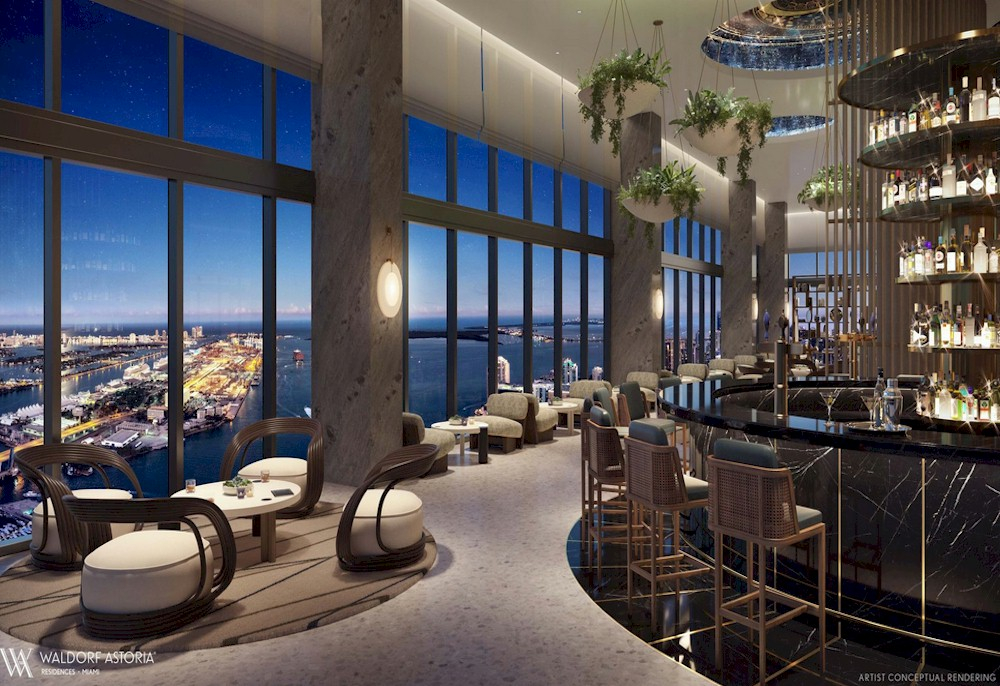
Delivering a sublime sanctuary for residents and guests that is still distinctly urban, Waldorf Astoria Miami features a 19th floor bar and lounge that BAMO enveloped in windows and a mirrored wall to inspire a liberating sense of expansiveness.
"The lounge features open space with windows on three sides, and the last wall is mirrored to give guests the sense of being in a glass-walled 'conservatory in the sky,'" explained Wilkinson. "With the connections to the sky and vista containing the ocean and the little bit of city, the space epitomizes the idea of an urban retreat, hovering in the clouds yet with access to activity down below."
Mirroring the fourth wall in the lounge interiors creates a sensation of being enveloped by the sky, light, and its reflections. In his work, Nick Albert – an architectural lighting design expert and founder of Chromatic, an advocacy-based firm foundationally rooted in advancing diversity and inclusion in lighting design – celebrates the malleability and transience of light in rendering a space and significantly influencing how people experience it.
One of his focus areas is using light to fulfill biological needs with respect to daylighting. When our bodies are responding to natural patterns of light and darkness, it positively impacts our sleep, level of relaxation and calm. Leveraging circadian adjusted lighting has biological, scientific benefits – not interrupting your sleep-wake cycle, not exposing yourself to as much blue lighting – and can have an emotional impact as well.
"If a building's lighting system can follow a circadian arc, it can anchor people," said Albert. "After deplaning, finding your luggage, and jumping in a cab, entering a space that feels more naturalistic can create a kind of decompression. It can even gesture toward walking out onto a deck with a cup of coffee at your favorite retreat or taking a walk on the beach after dinner. Lighting can help envision those cues in your mind's eyes. If you're at an urban hotel and we can't give you the beach, we can still make you feel relaxed, vibrant, or energized with lighting."
So, in the absence of outdoor space, it is possible to create the sensation of being outdoors, just as in the absence of natural light one can leverage lighting technology to achieve naturalistic cues associated with circadian wellness. LEDs that can change their color temperature from cool, crisp blues to bright neutral warms in the middle of the day and very warm, subtle calm lighting in the evenings can stimulate the natural circadian rhythms that our bodies and minds crave. In our new office space in San Francisco, Albert and his team integrated sophisticated light fixtures that have been designed to imitate windows, and skylight transoms.
"The LEDs will brighten and darken and warm and cool based on the quality of daylight in that particular part of the world, at that time, and at that side of the building – it is not a trick as much as it is decluttering, removing the mental anxiety that spaces can produce, and suspending the stress of the world beyond the room," said Albert.
LED technology gives you the flexibility to sync lighting components with other aspects of the building and base it on a human cycle rather than on purely mechanical considerations of when lighting should be on and off. Some building systems in general – HVAC, lighting, water, air quality, sanitization with UV light – are beginning to operate more as an operating system rather than as a set of discrete touchpoints. When all those pieces start to operate cohesively, you can build a wellness experience in which the building is not adversarial with its occupants. Instead, people are in sync with the space and the building is more in sync with what people are needing.
Lighting can be used in a space from an aesthetic and experience standpoint, and those same light fixtures, if leveraging the right technology – whether LEDs producing UVC or far spectrum UV – can help sanitize a space. Part of a natural cycle of a space is morning to noon and night when a guest is in it and when the guest departs from it; working within this cycle, a room can sanitize itself or the air moving through it using the same kind of sensor technology we utilize for energy efficiency.
The next step past using UVC lighting to sanitize a space is conveying to guests when the sanitization process has been conducted. That building intelligence can give guests peace of mind, delivering the mental wellness that they are entering a safe, clean space.
Whether through subtle cues like intentional sequencing in the built environment and interiors that blur boundaries between the inside and outside, or by leveraging innovative technologies in the spa and lighting, in the future, designing for wellness in urban hotel environments will demand more of a holistic perspective. Not just in the sense of how all elements of a building can work together to reinforce a sense of safety and well-being, but also looking at how the hotel can help enhance the surrounding neighborhood.
Does the lobby experience (or the prelude to it) draw in the larger public? How does the hotel building impact the wellness of the larger community, in terms of lighting? Can people still see the night sky, and is the brightness balanced to create a more inviting pedestrian experience?
Just as COVID-19 heightened our attention to the importance of safeguarding our individual wellness, it also underscored the significance of taking care of our communities, which will inform our design strategies going forward.