






Post-COVID-19: The New "Normal" in Hotel Design
By Lawrence Adams





In December of 2019, the pandemic caused by coronavirus or COVID-19 began in Wuhan, China, and has since spread globally. By May 3, 2020, there have been over a million cases with nearly 76,000 deaths in the US. The pandemic is fomenting havoc in the travel and hospitality industries. As business and leisure travelers stay at home, hotel occupancy rates have plummeted.
Occupancy rates in the US dropped to less than 20% in March and even lower in hot spots like New York City. All signs indicate that the current situation will get worse before it gets better, but there is optimism that a vaccine will be discovered and some semblance of normalcy will return to the traveling public – a new normal.
As this devastating virus subsides and travelers again take to the skies and roadways and look for overnight accommodations, they will seek lodging that guarantees them a high level of safety from disease. Hotel designers will face new challenges in the post-coronavirus new normal in travel and hospitality. Disruptive and innovative design will be essential to create spaces and experiences that make guests feel safe, secure, and comfortable in the post-COVID-19 world.
In this article, we will explore some ideas for design innovation and potential trends and approaches to hospitality design in the new normal. Many of these ideas for changes in hospitality design and operations might be applicable during a short term transitional period until an effective vaccine is discovered or will be more enduring as long term solutions that will shape the way we design hotels in the future. Time will tell.
Guestrooms
Prior to the pandemic, guests identified as Millennials have shown a strong preference for working and socializing in hotel public spaces while spending less time in their rooms. (See Millennials' Impact on Hotel Design ) In the new normal we might see a reversal of that behavior and a new emphasis on the guestroom experience, where technology and cleaning protocols will establish an authentic sense of safety and wellness. Guests may once again prefer the safe sanctuary of their rooms to the crowded lobbies and bars in hotel public areas so designers will be challenged with making the guestroom experience not only safe but invigorating and enjoyable.
Enhanced air purification will be a key component for the new normal guestroom. Advanced air purification systems that feature HEPA (High-Efficiency Particulate Arrestance) certified filtration systems that trap and reduce allergens and viral bacteria in particles of 0.1 microns or smaller in size may become the norm in guestrooms. Smart phone apps will allow guests to control and monitor air quality in their room in real-time.
Ultraviolet (UV) lights installed in guestroom air handling units could provide another level of air purification that can eliminate many types of fungi, bacteria, germs, viruses, and pathogens. UV lamps irradiating airflow in both upstream and downstream in air handling units would provide effective prevention to allergies and pathogens.
Smooth, cleanable materials, and surfaces, like those used in hospitals should be used throughout guestrooms. Wall-to-wall carpets, bedcovers and throw pillows, that have always been suspect as to their cleanliness, might become things of the past. New technology for fabrics that can be easily wiped clean, emulating antimicrobial materials used in laboratories could be utilized. Materials that mimic sharkskin, to which microscopic organisms have difficulty adhering, could be developed for upholstered furniture in guestrooms and public spaces. Designers should find ways to employ copper and its alloys, including brass and bronze, which are self-sanitizing and able to kill bacteria and viruses.
One infamous episode from the reality TV show, Hotel Hell, has Gordon Ramsay demonstrating with a UV light scanner just how filthy many guestrooms are, even after cleaning. Ramsay demonstrates that nearly every surface of a particular hotel room, in a luxury property, is contaminated with human DNA. The guestroom remote control, once thought of as simply unsanitary and gross, might now be perceived as deadly. Housekeeping staff will undergo rigorous training for new advanced cleaning protocols.
Complementary handheld UV lighting scanners that reveal residual DNA that can contain bacteria and viruses, may be offered in guestrooms to demonstrate to the guests a high level of cleanliness. Each room could be equipped with sanitization kits, including a UV wand, which guests themselves could use to clean surfaces like toilet seats, vanity tops and other surfaces, if they want to go the extra mile.
Touch-free technology that exists today will be expanded beyond automatic toilets, motion detection lighting, and voice command controls as we shall see in our discussion below.
Public Spaces
When spending time in public spaces, social distancing will affect layouts of furniture and circulation. Kinetic furniture (on casters) which was once intended to bring guests closer together with spontaneous grouping and huddling, might now be used for distancing and pushing apart furniture into less dense groupings. Smaller clusters of furniture would cater to families and familiar friends and associates. Communal tables, once celebrated for encouraging social interaction, might become smaller or discontinued altogether. Table spacing in restaurants and bars might be set so that a 6-foot safe distance is established. It would be ridiculous to space bar stools 6 feet apart so bar seating might be an "at your own risk" proposition.
Upon arrival, guests might be screened for infection before being allowed to register. Sophisticated non-intrusive screening systems for identifying potential infections for guests will be utilized before check-in. State of the art heat sensors could measure a potential guest's temperature upon arrival and report a fever to the registration desk personnel. Turning away a potential customer, who might be infected, will be a sensitive and controversial problem. Hong Kong has effectively implemented thermal scanners that office workers must pass through before entering the building elevators.
Public restrooms may get larger to allow wider spacing of fixtures. We might find that parameters based on ADA or Universal Design standards intended for mobility-impaired users are now applied to all bathroom fixtures to foster a sense of safe distancing. Automatic flush, faucets, and soap dispensers are already in common use in public restrooms as well as touchless hand driers, but we might add to that list automatic toilet seats that raise and lower on voice commands.
Safe spaces, sunlit, open-air, and super-sanitized might be in demand in hotels and can be rented for small public gatherings or offered free as a new luxury offering to guests. Safe spaces might be attractive to non-guest users, who will find those catered accommodations beneficial to their small gathering needs. Hotels might add to its revenue stream by marketing safe spaces for birthdays, anniversaries, bar mitzvahs, small business meetings, bridge clubs, or board meetings.
Large crowded meetings and conferences will be a major challenge in the New Normal. DELOS®, a wellness-centric real estate company, developed the DELOS Stay Well® Meetings protocol. The Stay Well Meetings program utilizes state-of-the-art air purification, chromatherapy, ergonomic furniture, aromatherapy, infused water hydration stations, UV wand cleaning tool, hypoallergenic products, self-cleaning photocatalytic coatings, circadian lighting, and healthy menu options.
Virtual Reality (VR) systems might provide for virtual participation at events and meetings. No need to buy expensive plane tickets and hotel rooms, when you can purchase and download the event app and participate from the comfort and safety of your office or home. VR then becomes a more sophisticated and realistic teleconferencing tool. Technology is advancing the use of 3D holograms for use in virtual meetings. It is now possible to have a tele-immersive conference using a high-definition 3D imaging platform where participants meet from a distance. This trend is also ecologically sustainable since fossil fuel consumption from air and auto travel would be dramatically reduced. (see The Future of Meetings & Technology )
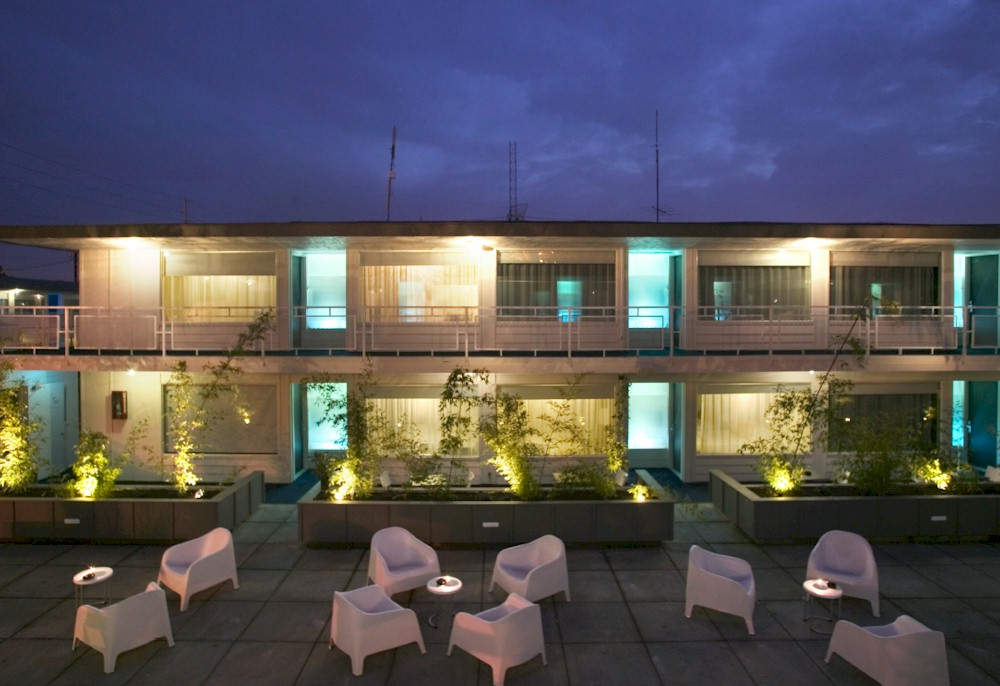
The Jupiter Hotel in Portland, Oregon was a 1960s Motor Lodge that was transformed into a stylish boutique hotel. Guests walk up stairs and enter their guestroom from a breezy sunlit balcony, avoiding elevators and crowded corridors.
Vertical Transportation and Corridors
Elevators are a big problem for social distancing. No one will want to ride in a crowded elevator cab for the foreseeable future. Destination direct elevator controls, ones that allow guests to select their destination floor before entering the cab, could be retrofit to give guests the choice of calling a private car for a single guest, a family, or a group of close friends or business associates. Since this type of system would slow response time, the option of sharing the cab with a limited number of people may be offered.
Sensors in the elevator would monitor the number of guests in each cab before it arrives. One might feel relatively safe sharing a ride with two or three other guests. Elevators could be programmed to allow no more than 6 people in a cab, no matter what the relationships. A sanitizing mist of disinfectant might be released in the elevator cab each time it is emptied, providing guests with an additional layer of safety from exposure to pathogens.
The prototypical model of a roadside motel might once again be embraced as it possesses attractive safe distancing characteristics. Use of elevators and cramped corridors are avoided in three- or four-story walk-ups where the guestroom is entered from a sunlit and breezy exterior balcony or walkway. It is difficult to imagine this working in an urban context, but new resorts or suburban hotels might find this application viable. Developers might need to sacrifice valuable floor area to provide wider corridors and more spacious elevator lobbies in urban hotels.
Parking capacities in hotels might become a challenge as more guest will arrive in their private vehicles to avoid air travel, taxis and ride-hailing companies. Lower occupancies might initially offset this trend but the issue will eventually need to be addressed. Valet parking might become unpopular as arriving guest will prefer to park their own cars and avoid the potential contamination. Guest might need to park remotely and be shuttled back and forth to the hotel.
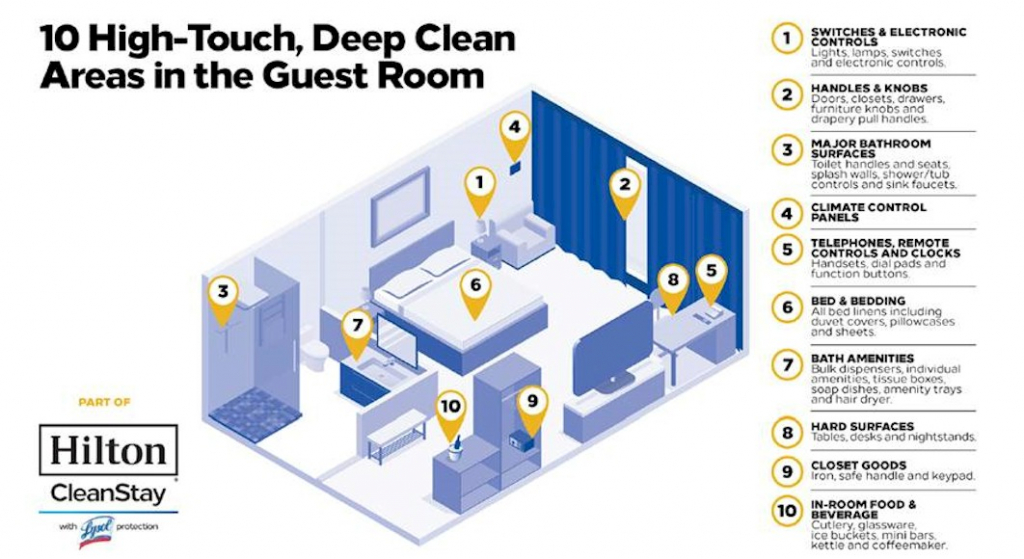
Hilton International is launching its Hilton CleanStay with Lysol Protection program this summer. Using touchless technology and advanced cleaning protocols, guests are assured of a high degree of hygiene and safety from pathogens.
Touchless Technology
An important method for reducing the risk of viral spread is to reduce the number of shared surfaces like doorknobs and pulls, elevator buttons, money, credit cards, public toilet fittings, etc. Touchless technology has been with us for many years. Automatic flushing toilets and urinals that use infrared sensors to detect body heat and activate a flush mechanism when the sensor detects the loss of heat, has been in use in public restrooms for decades. Hands-free faucets and soap dispensers are based on the same technology. The new normal in hotel design will look for new ways to expand touchless technology to maximize hygienic safety for guests.
Motion-activated lighting in guestrooms is already in use in many hotels mainly as an energy-saving system where lights simply turn off if no one is in the room. Today LED low-voltage lighting coupled with PoE (Power over Ethernet) switching technology is advancing automatic touchless light switching to new levels. It is now possible for a guest, using a smartphone app, to control light levels, select dimmer scenario options, even color and brightness of lighting without ever touching a wall or lamp switch.
Smartphone guestroom apps will be able to unlock and open the entrance door, control shower and tub settings and temperature using solenoid valves, select room temperature and humidity, monitor air purification levels, activate window shading devices including smart glass electronic tinting of windows, engage TV and sound systems, set up a virtual video or VR in-room meeting, select and order meals or other products from room service, request engineering or housekeeping and pay the hotel bill.
Many of us use voice activation systems in our homes. Devices such as Alexa and Google Home allow us to perform many touchless tasks such as dimming lights, turning on and controlling the television, locking or unlocking doors, adjusting HVAC, activating the security system, and even turning on the coffee maker. We are starting to see voice command systems used in hotel guestrooms for many of the same functions. Volara is collaborating with Amazon Web Services (AWS) to develop Amazon Echo Dot devices in many hotel brands by allowing guests to use voice commands for concierge services and in-room controls. Guests can learn the WiFi password, local attractions, current or forecast weather, and hours of operation for the rooftop restaurant without ever touching a phone.
Facial recognition is starting to be used in hotels primarily to automate certain verification or authorization processes. This technology is being used to give guests access to their hotel rooms and can provide authorization for staff to enter secure areas of the hotel. For check-in, the guest might be identified at a kiosk to streamline registration. Payment authorization becomes more efficient with point-of-sales or upon check-out. Facial recognition may also be used as an enhanced security system to recognize potential criminal or terrorist threats before they enter a hotel lobby. (see Enhanced Security Systems for Hotels and Resorts: Threat Detection and Avoidance )
Touchless payment transactions may utilize Smart POS (point of sale) or contactless Smart Terminal, Tap to Pay with a contactless indicator, or mobile payment using the smartphone device that scans a bar code or QR code on the phone. Apple Pay even allows you to pay using your Apple Watch. Trains and buses in many cities now allow you to use your Apple Watch to board.
Brand Standards
The International WELL Building Institute (IWBI) established a certification system for measuring and evaluating features of the built environment that impact human health and wellbeing. IWBI provides a rating system similar to LEED certification that ranges from basic WELL certification to Silver, Gold, or Platinum WELL certification. Among the metrics used in WELL certification, air quality is a major category. In response to COVID-19, we might see WELL Building Standards and certification become stricter and have new stringent requirements. WELL Building Platinum "Plus" might be created to certify a hotel as essentially free from exposure to pathogens. (see The Wellness Trend in Hospitality ).
Perception of trust with large established hotel companies' cleaning protocols might trump those of untested off-brand boutique hotels. Companies like Marriott, Hilton, Hyatt, and Accor would benefit from this guest perception. Brand proliferation might reverse as unique brands will be less appealing in a matter of trust, tried, and true. Travelers may become less adventurous. Strict brand standards will be demanded. Airbnb may flourish at first due to its safe-distancing advantage but may eventually go away due to a lack of strict sanitization protocols and standards.
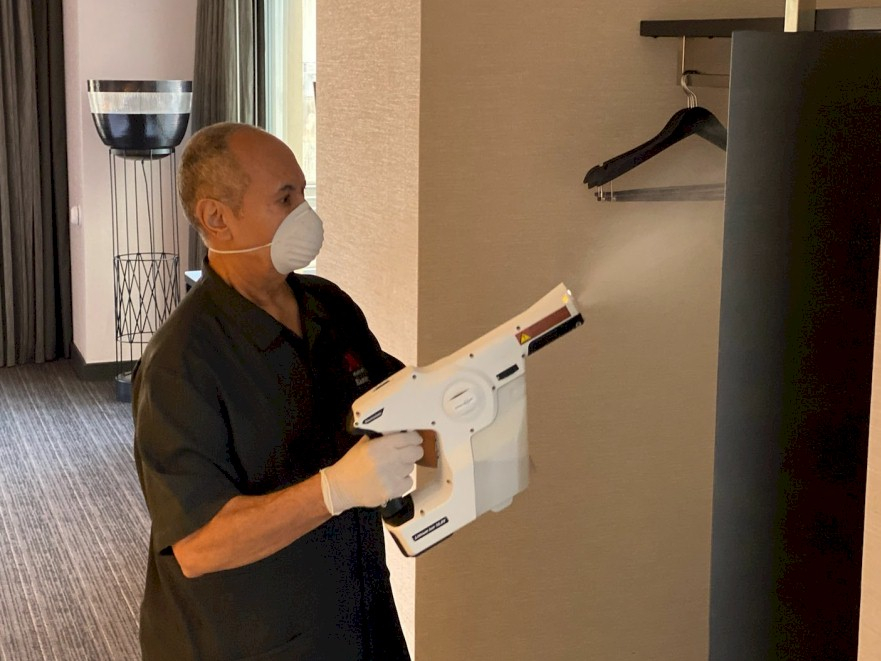
Marriott International has launched the Marriott Global Cleanliness Council to establish a higher level of housekeeping standards including the use of electrostatic sprayers with hospital-grade disinfectants to sanitize guestrooms and public spaces.
Cleaning Protocols for Major Hotel Companies
In response to the coronavirus pandemic, major hotel companies have upped their game in establishing cleaning protocols, training and operational procedures to ensure the safety and wellbeing of their guests.
Marriott International has launched the Marriott Global Cleanliness Council to establish a higher level of standards to holistically minimize risk and enhance safety for its guests and staff. Marriott housekeeping is using electrostatic sprayers with hospital-grade disinfectants to sanitize guestrooms and public areas throughout its hotels. The company is also using ultraviolet technology to sanitize keys and devices shared by guests and staff. Marriott guestrooms will provide disinfecting wipes available for guests' personal use.
Hilton is launching its Hilton CleanStay with Lysol Protection program this summer. In collaboration with RB, who makes Lysol and Dettol, and in consultation with Mayo Clinic Hilton is developing training and processes to further elevate its standards of housekeeping and hygiene. Working with the infectious disease specialist at Mayo Clinic, Hilton is translating best practices in hospital hygiene standards to hotel guestrooms and public spaces. To assure the guest of a room's cleanliness, a Hilton CleanStay Room Seal will be placed on guestroom entry doors as an indication that the room has not been accessed since being thoroughly cleaned. Like Marriott, Hilton is utilizing electrostatic sprayers and ultraviolet technology in its enhanced cleaning protocols.
All of the major brands are rolling out enhanced cleaning protocols and operation procedures to assure customers of their commitment to safety and hygiene. Hyatt is introducing its Global Biorisk Advisory Council (GBAC) accreditation by employing microbial-pathogen threat analysis and mitigation. Accor has joined forces with Bureau Veritas, a provider of testing, inspection, and certification, to develop a label to certify safety standards and cleaning protocols for its properties.
Think Positive
Look on the bright side. Not all of the enduring changes to design, development, and operations of the lodging industry caused by coronavirus will be negative.
As hotels have occupancies reduced to 20% or less, with many closing altogether, many developers and operators will see the opportunity to acquire, renovate or reinvent properties that have been long overdue for a makeover. Architects and Designers could get busy as owners and developers rebrand and reposition properties during this new normal down market in anticipation of an industry rebound.
As described above, hotel companies are revamping and upgrading their cleaning protocols. Those new standards are likely to endure after the virus subsides as customers will continue to demand a high level of safety and enhanced hygiene for the foreseeable future. Research in disease control and virus protection will yield new technologies to address the health and wellness of lodging. Technological advances in air purification will continue to improve air quality in hotels.
Technology that advances remote participation in meetings and conferences will continue to develop. VR, AR, and holography will improve dramatically allowing remote participants to attend, present, network and engage to make the meeting experience-rich, effective, and rewarding. Remote participation at conferences will have the added ecological benefit of reducing the use of fossil fuels as auto and air travel will become less necessary.
Touchless technology will continue to advance with voice activation, facial recognition, smart-phone controls, motion detection and PoE switching systems continue to find utility in not only keeping hotels safe but enhancing the guests' hospitality experience to new levels.
In the final analysis, the technological advancements and enhanced operational procedures precipitated by the current crisis may have the unexpected impact of enriching the hospitality experience beyond what it was at the beginning of this year. We may indeed find that human nature will again prevail and through ingenuity and endurance turn this seismic shift in our industry into a positive outcome.