






Green Hotels: Overcoming the Overwhelming
By Ewald Biemans






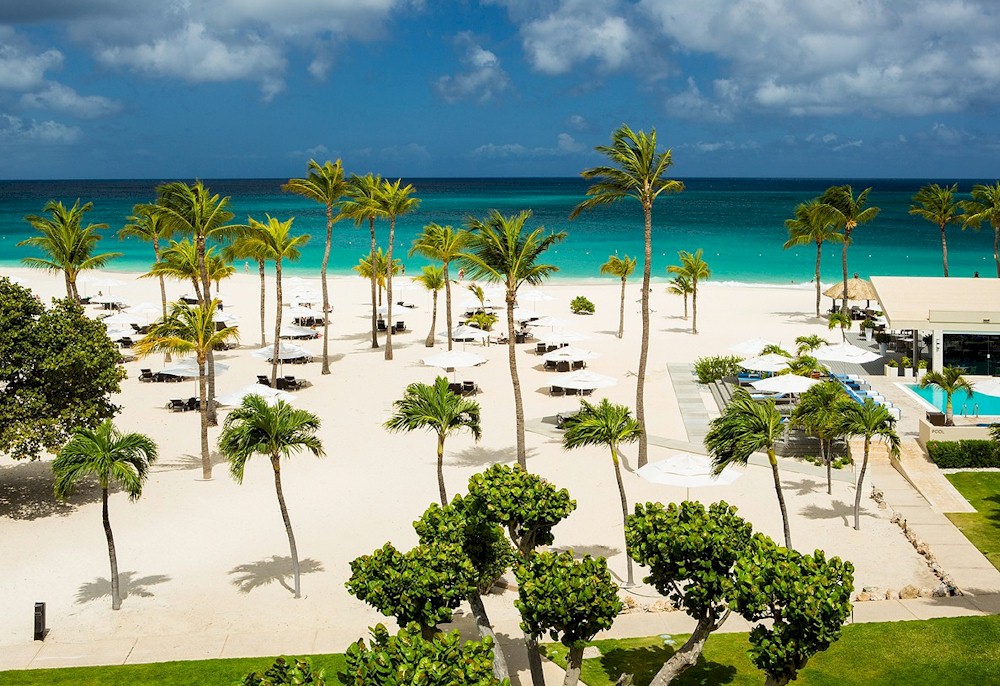
Our planet is ill. As hoteliers, with the pressing issues we face daily, it just can be too much to focus on screaming headlines such as "Extremes of 40C above normal: what's causing 'extraordinary' heating in polar regions? " in The Guardian, "How climate change is hurting living things on Earth right now, according to a new report, " according to NPR, and sadly even, "War's Toll on Ukraine's Once Vibrant Environmental Movement " from Inside Climate News.
Frankly, it seems easier to focus on what's in front of us right now – restoring business to pre-pandemic levels, profit and loss statements, construction, guest satisfaction, inflation, and of course, finding enough staff.
As hotel executives, the sustainability of our properties does fall on our shoulders and that is part of right now, as well. Many hotels have at least dipped their toes into some form of sustainability, but now, our guests are demanding more. And, as 10% of the world's GDP, the travel sector has the great honor and obligation to be responsible stewards of our shared home.
On November 4, 2021, in a meeting room at the much-anticipated and highly covered 2021 United Nations Climate Change Conference, better known as COP26, hospitality and transportation representatives from the world over launched the Glasgow Declaration for Climate Action in Tourism. Regardless of where we hailed, we all spoke the same language: climate action in the travel sector. I am humbled having been asked to be the sole hotelier to be a launch signatory. Other signatories represented aviation, destinations and tour operators.
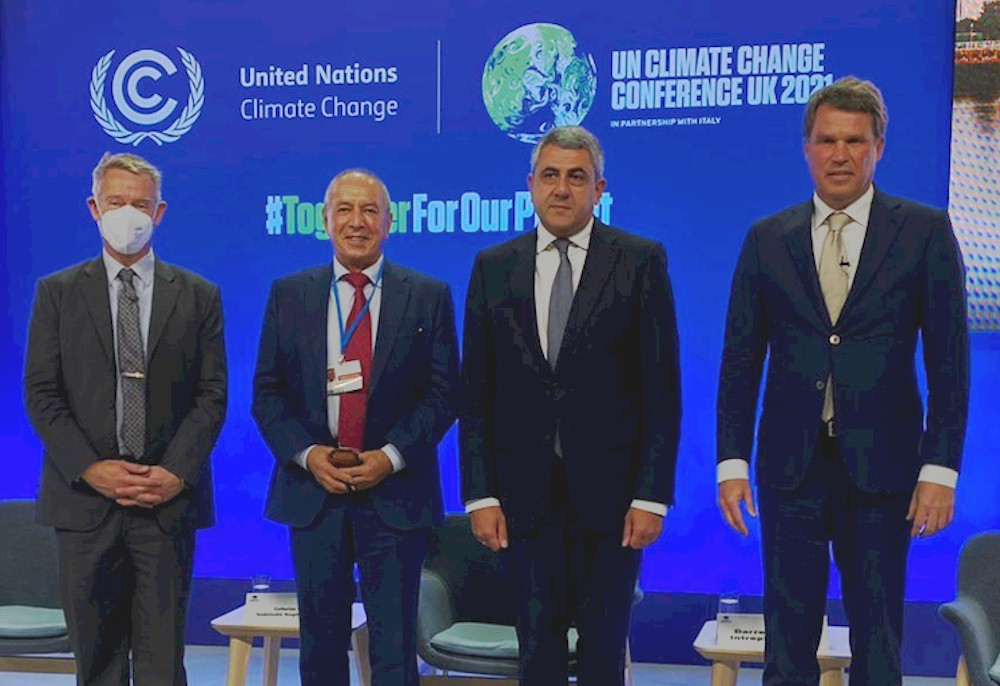
Author Ewald Biemans, owner/CEO of Bucuti & Tara Beach Resort, Aruba, (second from left) was invited to be a launch signatory of the Glasgow Declaration for Climate Action in Tourism by members of the World Tourism & Travel Council (far left, far right) and Zurab Pololikashvili, Secretary-General of the United Nations World Tourism Organization (UNWTO).
Simultaneously, as the year was drawing to a close, results of a new study by giant search engine Google revealed travelers' top six search criteria for 2022 travel planning: life moments, value, health safety, community first, digital presence, and sustainability.
As you read, some examples are from my property, Bucuti & Tara Beach Resort in Aruba. Reason being, we are the Caribbean's first and only certified carbon-neutral hotel. At 104-rooms, our adults-only property is the Caribbean's most eco-certified hotel, it is also the No. 1 Hotel in the Caribbean per Tripadvisor and pre-COVID occupancies were humming at 97 percent year-round. Bucuti & Tara continues to prove that a sustainable operation, vacationing, and profitability can be mutually inclusive. Bucuti & Tara shows that becoming certified carbon neutral has upgraded our brand to become the choice for the fast-growing number of guests who make their hotel choices based on operating responsibly. I am openly sharing how to become carbon neutral for those heeding the urgent call to do so.
Inflection Point and How to Help Your Property
Continuous, more alarming media coverage, government and watchdog reports, and even the powerful student protests routinely led by teen activist Greta Thunberg remind us that the health of the planet, our shared habitat, is in critical danger. Directly or indirectly, we all are affected by climate change. It can span devastating storms that hit a hotel and rising utility consumption, or supply-chain issues and higher costs due to drought-affected food. For most properties, the consequences of climate change are felt both ways.
For my oceanfront property, Bucuti & Tara Beach Resort in Aruba, my threat is rising sea levels, depleted natural resources and marred landscapes. For those of us operating resorts in beach locales and nature destinations, we are in the nature business, not the tourism business, for without nature, there is no tourism. I came to this realization decades ago as I watched our tiny little island of beautiful Aruba become dotted with cranes and heavy construction projects. People come for our stunning powdery white sand beaches and turquoise-clear seas. Eagle Beach is affectionately known as one of the "Dream Beaches of the World," however, if climate change is not halted, in just 20-30 years, guests will have to snorkel just to see the beach.

If climate change is not stopped and rising sea levels stopped, in just 20-30 years, guests will have to swim just to see the current beach.
Combined with the power of the hospitality's first completely overarching sustainability commitment and the growing awareness and growing demand from travelers' for more responsible experiences, it has never been easier or more crucial to put sustainability efforts into overdrive.
The Glasgow Declaration is the widest overarching rally cry that positions every single hospitality entity to commit. This includes airlines, hotels, cruise, ferry, train or car companies through to operators and agents, government and institutional agencies, associations, consortia, donors and financial institutions and academia.
The hospitality industry is responsible for 8% of global greenhouse emissions per Sustainable Travel International. Aviation alone is responsible for 12% of greenhouse gas emissions within the overall transportation sector according to the Air Transport Action Group (ATAG). The non-profit association represents all sectors of the commercial air transport industry and provides a platform for the commercial aviation sector to work together on long-term sustainability issues.
Released in September 2021, data from the latest Cornell Hotel Sustainability Benchmarking (CHSB) Index shows that the average carbon footprint of a hotel stay decreased by 3% between 2018 and 2019, following a decrease of 10% between 2015 and 2018. The issue is that it's not nearly close enough to being reduced as fast as needed according to the globally accepted Paris Agreement.
By becoming a signatory of the Glasgow Declaration, you join a community of forward-thinking hoteliers who recognize that sustainability is as important as superior guest service.
Sustainability No Longer Sleeps on a Rollaway Bed
Within the earlier referenced Google Travel Trends 2022 report, according to Ipsos, environmental considerations are important to potential travelers. 51% of travelers who stayed in accommodations or booked a flight say sustainable or environmentally friendly options are important when deciding on a brand. More than 50% of travelers saying considerations such as carbon emissions and offsets are worth important when considering travel. Booking.com reports recent traveler survey findings from 29,000 respondents spanning 30 countries that 81% want to stay in a sustainable accommodation in the next year of travel, 72% think companies should offer more sustainable choices, and 73% are more likely to choose an accommodation if it has implemented sustainable practices.
Climate change naysayers are quickly becoming the outliers.
The Path to Carbon Neutrality
Why is it that when we are onboarding new staff, implementing training programs, doing performance appraisals or during unfortunate times, addressing disciplinary situations, that it seems much easier than taking on sustainability?
People created a roadmap. It feels tangible to us. Human Resources is necessary. The same has become of sustainability. The roadmap to creating a sustainable hotel is here now, too.
Step 1. Become a Signatory
The Glasgow Declaration aligns the travel and tourism sector with the world in the Race to Zero. Every hospitality entity of any size throughout the world spanning hotels, transportation, tour operators and more can become a signatory of the Glasgow Declaration. The Glasgow Declaration unites travel and tourism behind a common set of pathways for climate action, aligning the sector with global commitments and catalyzing collaborative solutions to the many challenges facing businesses and destinations globally. It encourages the acceleration of climate action in tourism by securing commitments to reduce emissions in tourism by at least 50% over the next decade and achieve Net Zero as soon as possible before 2050.
Signatories agree to deliver or update climate action plans within 12 months, align plans with the five pathways of the Declaration (Measure, Decarbonize, Regenerate, Collaborate, Finance), report publicly on an annual basis, and work in a collaborative spirit, sharing good practices and solutions, and disseminating information.
This all may sound overwhelming, however, consider it the overall strategy for achieving your goal. Like any strategy, it is broken down into actionable initiatives.
If you have heard of the UN's Sustainable Development Goals (SDGs), yet have never thought how they apply to your property, you're in luck. This commitment positions you to level up your property bridging good intentions with recognized, impactful climate actions. The Sustainable Development Goals form the framework for improving the lives of populations around the world and mitigating the hazardous man-made effects of climate change.
Step 2. Create the Framework
The best way to create the framework for applying or furthering sustainability efforts for a property is to begin with eco-certifications. There are many certifications, however, there are standouts that have become easily recognizable such as LEED.
It is highly beneficial to have a sustainability manager on staff. The position can pay for itself with the right framework in place complete with well-executed and tracked initiatives. For example, the year Bucuti & Tara traded single-use toiletries for in-shower dispensers, we spent only US $10,500 on these toiletries versus individual bottles that would have cost US $50,600 – a savings of 79 percent! Plus, it removed the unnecessary production, transportation and eventually waste had we gone with the estimated 91,000 single-use bottles. If adding a sustainability manager to staff is not an immediate option, begin working with each department. All it takes is one initiative to begin building towards a more sustainable operation.
Certifications reflect best practices. Jump start your path to providing a safer, healthier more sustainable travel experience by exploring eco-certifications. Becoming carbon neutral is not about simply purchasing carbon offsets to cover your property's existing footprint. It requires scrutinizing every department's standard operating procedures and establishing a plan that arrives at absolutely minimizing the emissions offset gap. These certification requirements help guide your property in the right direction of sustainable design, responsible procurement, renewable energy and ultimately, reduced carbon emissions.
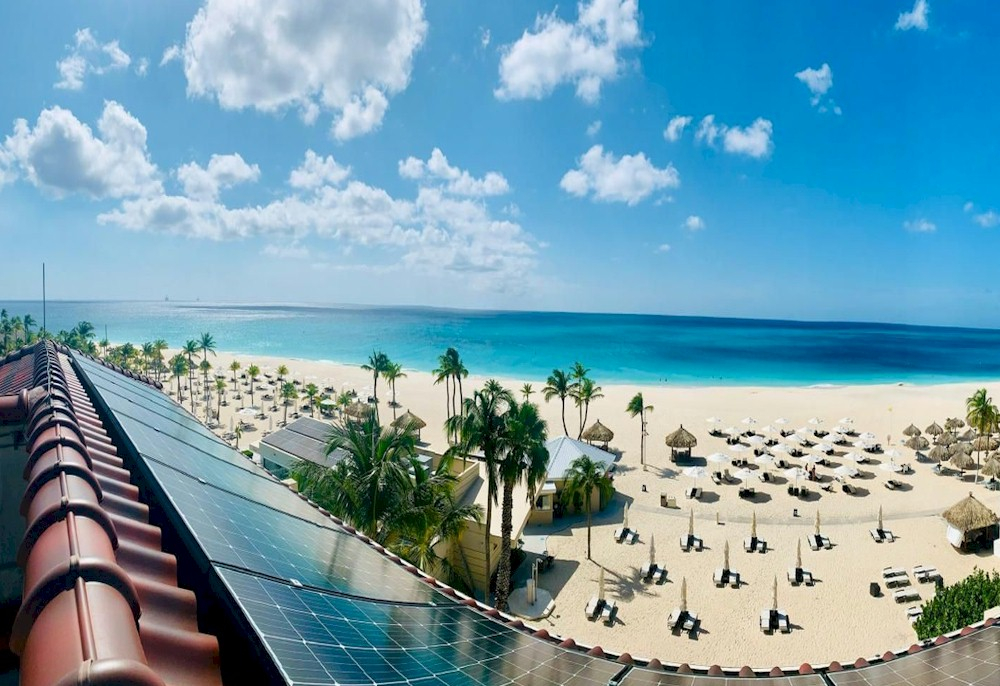
Renewable energy is a start and certifications reveal how other initiatives help decrease carbon emissions throughout every department.
Renewable energy is one of the first major impactful initiatives that comes to mind these days. Eco-certificates help guide that. As expected, they go far beyond. For example, Bucuti & Tara is in the midst of painting interiors and exteriors with MIG insulating paint. This initiative alone will reduce the resort's current energy consumption by another 20-25%. Solar-heated hot water on the resort's rooftops harness Aruba's abundant sunshine so there is less dependence on gas to heat water for the operation. A planned new air-conditioning system that fits within eco-certification guidelines will soon result in 10% less energy consumption.
A Healthy Portions initiative in 2016 followed by a partnership with the World Wildlife Fun resulted in food waste reductions of 30% per initiative. Now, 68% of overall resort waste is reduce, reused or recycled and therefore diverted from the landfill. In 2022, the property will take the administrative offices off the main grid and power them on a microgrid. The certifications help create a specific roadmap to your property.
Step 3: Monitor and Track
The requirements built within the various eco certifications require ongoing monitoring, tracking and reporting of metrics. Once implemented, it becomes easy to identify problem areas that might even reveal hidden costs to your property such as faulty insulation that's running up your utility costs, emitting more CO2 emissions and increasing the size of your carbon footprint. Ultimately, it is rewarding to monitor the overall health, per se, of your operation.
Quite frankly, this built-in accountability factor can lead to greater morale as more positive numbers are reported. Additionally, your property has the opportunity to influence guests, staff and vendors in their own personal routines to opt into more sustainability efforts in their own lives.
Built-In Opportunities to Drive the Bottom Line
Taking our shared ethos, it is easy to begin working together and supporting one another. Fellow Global UN 2020 Climate Action Award winner Dallas-Fort Worth International Airport is the first carbon-neutral airport in the Americas. The DFW market happens to be a key market for Bucuti & Tara Beach Resort, Aruba. Combining forces, those guests looking for sustainability as a part of their travel criteria can now enjoy selecting a carbon-neutral airport to fly to and from a carbon-neutral resort. As an added bonus, in September 2021, Bucuti & Tara debuted the world's first Carbon Offset Concierge service. Guests can now offset their flights, airport transfers and even island excursions through verified offset programs. The bottom line: Guests enjoy a door-to-door carbon-neutral vacation.
Celebrate Guilt-Free Travel
Coming off the first two years of the COVID-19 pandemic was met with a hot bed of war, conflict, supply chain issues, workplace locations and changes to patterns once thought bedrock. The effects of COVID-19 have been terrible, absolutely crippling physically, emotionally and financially, and yet, the most devastating pandemic of our time is actually climate change. However, we do have an opportunity to create something positive.
Colleagues and guests are often surprised to learn that air travel to a resort like Bucuti & Tara Beach Resort in Aruba is less harmful to the environment than the equivalent of the same distance traveled in an automobile.
For comparison, both the mode of transportation and the seven-night stay were examined based on two people since most guests at the adults-only resort are couples. For simplicity's sake, flying nonstop from New York to Aruba for a one-week vacation has total carbon emissions of 1043.20 kg. Using the U.S. Environmental Protection Agency's passenger vehicle emissions calculations, the equivalent automobile vacation has total carbon emissions over three times that amount at 3305.23 kg. Therefore, the benefit of flying with a few hundred people plus the significantly lower carbon footprint at Bucuti & Tara versus the average American household (Cool Climate Network, a university, government, business, NGO partnership at the University of California, Berkeley) far outweigh a two-person road trip.
Curious about finding a flight's carbon emissions? Google makes it simple as it includes it in every flight search. Airlines even provide a multitude of verified carbon offset programs. With the resort stay already being carbon neutral and by offsetting flights, which is minimal (i.e. $3-6 per ton with NYC to Aruba roundtrip being approximately 1.5t), a guilt-free vacation is easier than ever.

Working with local school children to teach them entrepreneurial skills and sustainability to help them have a brighter future.
Guests Are Seeking More Transparency. Lean Into it
Some travelers are content with knowing they've selected a property that prioritizes sustainability – and that's all they need. The simply want that feel-good feeling and they want to show up and enjoy their stay. After the past two years of pandemic living, many people consider it a well-earned right for a completely laidback vacation.
Others love the idea of being invited to join in the efforts. (Talk about skyrocketing loyalty vibes!) At Bucuti & Tara, guests can participate with staff in monthly beach clean-ups, a 28-year tradition that removes 500 – 1,000 lbs. of debris annually keeping our marine life safe and white sand beaches, a natural nesting ground for vulnerable sea turtles, pristine. Guests enjoy our weekly sustainability tour, learn how our initiatives help shape government policy such as banning single-use plastic, styrofoam, and any unsafe sunscreens that can damage the surrounding coral reefs.
They participate in Pack-for-a-Purpose providing school supplies and games to a local children's home. They discover the resort's support for Aruba's Donkey Sanctuary as they make new furry friends, and even learn how the resort's community initiative for an island-wide spay/neutering and microchipping program has served 29,000 local dogs and cats. (Oh, hello authentic travel experiences!).
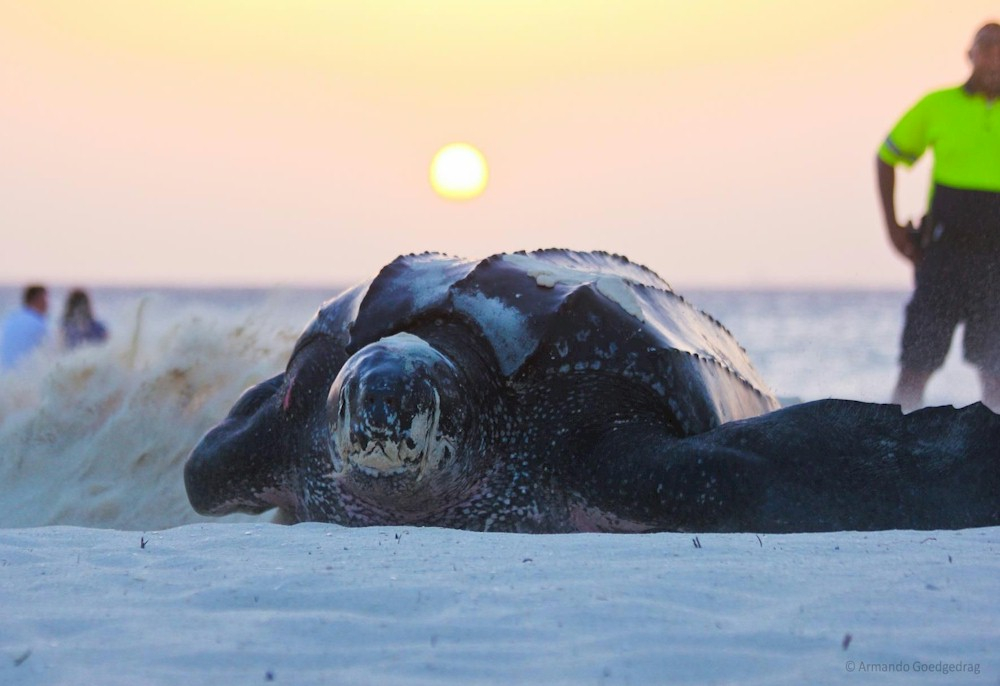
Going carbon neutral helps our shared environment thrive.
How May I Be of Service?
Back on March 26, as my property participated in the annual practice of Earth Hour 2022 where the global community switches off lights 8:30 to 9:30 p.m. local time, a staff member reminded us of something critical. As we prepared for the special Earth Hour guided meditation we streamed online that evening, our yoga instructor reminded all of us that humans are an extension of the planet. When we are not taking care of ourselves, we are not capable of taking care of anything else. Following best practices begins with us so that hopefully, our planet has a fighting change.
At Bucuti & Tara, we are journeying to our next goal – carbon negative. One of our current initiatives is going 100 percent paperless – we are 95 percent there. In 2020, the United Nations Framework Convention on Climate Change Award committee proclaimed Bucuti & Tara's sustainability model "highly replicable and scalable." To learn more about how the resort has incorporated sustainability while continuing to grow profitable revenue, we invite you to contact us with questions on how your property can become carbon neutral.